
Last updated July 13, 2026
The Complete Guide to Gate Repair in Vancouver
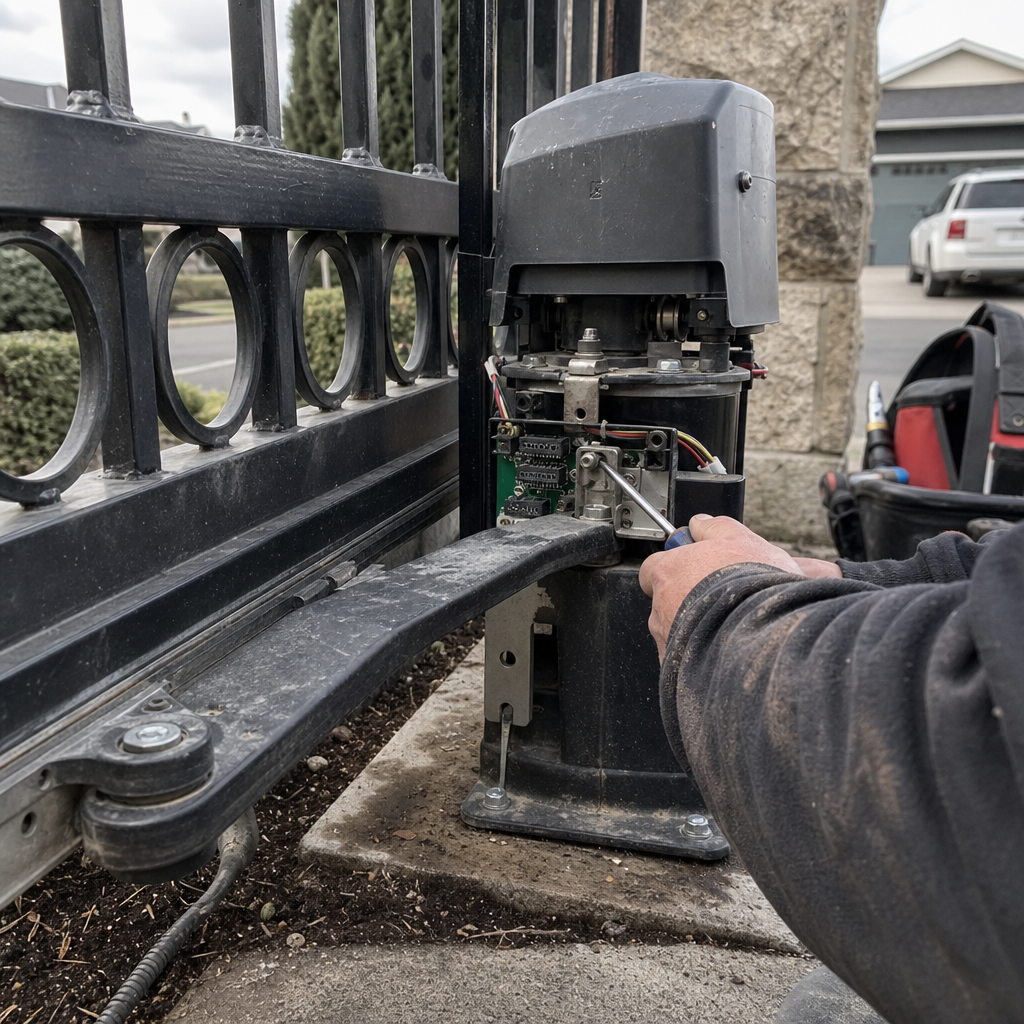
After 11 years and hundreds of service calls across Vancouver, the same misdiagnosis shows up repeatedly: a gate labeled “motor failure” that’s actually a sheared cotter pin on the arm bracket — a $12 part that costs homeowners $800 when the wrong tech replaces the operator instead. We’ve seen this pattern in homes from Cascade Highlands to Felida, and it points to a deeper problem: most gate repair in Vancouver isn’t failing because of bad luck. It’s failing because the person diagnosing it doesn’t understand the specific system installed. This guide maps what actually breaks, why your brand matters, and how Vancouver’s wet winters and freeze-thaw cycles create predictable failure patterns that a general handyman will miss.
Quick Answer
Gate repair in Vancouver typically costs $150–$650 for mechanical fixes and $280–$1,200 for motor or opener repairs, with most residential jobs completed same-day. The repair path depends entirely on your gate’s brand and failure type — LiftMaster, FAAC, BFT, Linear, and Viking systems each have distinct diagnostic codes, common failure points, and parts availability that determine whether you need a $30 adjustment or a $900 component replacement. In Vancouver’s climate, water intrusion and freeze-thaw stress account for roughly 60% of the non-motor mechanical failures we see annually.
Table of Contents
- Why Gates Fail in Vancouver: The Four Root Causes
- Brand-Specific Failure Patterns: What Breaks on Which System
- How to Read Your Gate’s Error Codes Before Calling Anyone
- How Vancouver’s Winters Destroy Gates (And What to Check)
- When Welding Beats Replacing: The 20% Repair
- The Owner-Operator vs. Franchise Difference in Pricing
- Common Mistakes to Avoid
- When to Call a Professional
- Frequently Asked Questions
Why Gates Fail in Vancouver: The Four Root Causes
After 527 customer reviews and 11 years of continuous operation in Vancouver’s gate repair niche, we’ve learned that nearly every failure traces back to one of four root causes. Understanding which one you’re dealing with saves you from the replacement upsell and the misdiagnosis cycle.
Cause 1: Mechanical wear at pivot and hinge points. Gates in Vancouver move through 180–365 cycles per year on average, and the Pacific Northwest’s persistent moisture washes lubricant away faster than drier climates. We see this most in older estates near the Columbia River Gorge, where wind load adds shear stress to already-dry hinges. The symptom is a gate that opens slowly, stalls mid-travel, or grinds audibly. The fix is rarely the motor — it’s typically hinge realignment, bushing replacement, or arm bracket reinforcement.
Cause 2: Water intrusion into control boards and limit switches. Vancouver’s 42+ inches of annual rainfall finds its way into every enclosure that isn’t properly sealed. FAAC and BFT systems are particularly sensitive here because their limit-switch housings sit low on the operator body, directly in splash range from driveway runoff. We’ve replaced dozens of perfectly good FAAC 740 operators in Hough and Arnada neighborhoods when the actual failure was a $14 limit switch corroded by standing water.
Cause 3: Freeze-thaw cycle damage to masonry and structural mounts. Vancouver’s winter temperatures swing between 28°F and 45°F repeatedly, causing concrete gate posts to micro-crack and shift. A post that moves 3/8 inch is enough to throw a swing gate’s geometry off, creating binding that the motor interprets as an obstruction. The motor isn’t failing — the gate is fighting itself.
Cause 4: Electrical supply instability and grounding issues. Rural properties east of Vancouver toward Camas and Washougal experience voltage drop on long runs from the house to the gate. Viking and Linear operators are particularly susceptible to low-voltage lockout, which mimics a dead motor. Before you authorize a $600 operator replacement, a voltage test at the gate takes 90 seconds and costs nothing.
Brand-Specific Failure Patterns: What Breaks on Which System
This is where most gate repair in Vancouver goes wrong. A technician who “works on all brands” is guessing. Each major manufacturer engineers failure points into their systems — not intentionally, but through design philosophy — and knowing which brand you own determines the diagnostic sequence before anyone touches a tool.
LiftMaster (Chamberlain Group)
LiftMaster residential operators dominate Vancouver’s newer subdivisions — Fisher’s Landing, Salmon Creek, and the Ridgefield area especially. The common failure is the internal gear set in the LA400 and CSW200 series. The symptoms are a motor that hums but doesn’t move the gate, or a grinding noise followed by stall. The gear set costs $45–$85; the full operator replacement runs $850–$1,400. We’ve done this repair in Vancouver’s Bella Vista neighborhood six times in the past two years — always the gear, never the motor itself.
LiftMaster’s MyQ connectivity boards also fail with moisture exposure. The board sits horizontally in the housing, collecting condensation. If your gate responds to the remote but not the app, and you’re in a damp area like Vancouver’s Old Evergreen Highway corridor, suspect the board before the motor.
FAAC (Italian, common in high-end installs)
FAAC 740 and 422 operators appear throughout Vancouver’s custom home market — Camas Heights, Prune Hill, and the waterfront properties along the Columbia. FAAC’s hydraulic systems are robust but hydraulic fluid degradation is the hidden killer. After 5–7 years in Vancouver’s temperature swings, the fluid thickens and the operator develops “morning sickness” — slow operation when cold, normal when warmed. A fluid change and seal kit runs $180–$260. A replacement operator is $1,800–$2,400. The diagnostic test: time the gate’s open cycle at 8 AM versus 2 PM. If the difference exceeds 4 seconds, it’s fluid, not mechanics.
FAAC’s limit switches are also moisture-vulnerable, as noted above. We carry sealed aftermarket replacements specifically for Vancouver’s climate.
BFT (Italian, growing presence in commercial)
BFT systems appear increasingly in Vancouver’s multi-family and HOA installations — the Mill Plain corridor, Van Mall North, and commercial properties near the Port. BFT’s encoder-based positioning is precise but unforgiving of mechanical slop. When a BFT gate “loses its position” and slams or stops short, the problem is rarely the encoder. It’s typically loose drive belts on the subterranean SUB or ARES series, or worn nylon gears in the ELI series swing operators. Belt tensioning is a 20-minute adjustment. Encoder replacement is a $400+ parts order with 2-week Italian shipping.
Linear (Access Control Products)
Linear operators — the PROSWING, PROSLIDE, and ACT-31 series — are workhorses in Vancouver’s agricultural and rural properties, particularly north and east toward Yacolt and Amboy. Their control board capacitors fail predictably after 6–8 years, especially with voltage fluctuation. The symptom is intermittent operation: works Monday, dead Tuesday, works Wednesday. Capacitor replacement is $120–$180. Full board replacement is $340–$520. We stock the common Linear capacitor values because this failure is so predictable in our service area.
Viking (commercial and heavy-duty residential)
Viking systems appear in Vancouver’s estate properties and small commercial sites — the Hockinson area, Battle Ground periphery, and some industrial near Fourth Plain. Viking’s magnetic limit switches are sensitive to metallic debris and corrosion. When a Viking gate “forgets” its open or close limit, the first check is the magnet position and switch housing — not the control board. We’ve found rust flakes from the gate’s own hardware interfering with switch function. Cleaning and re-gapping takes 30 minutes. Board replacement is $500+ and unnecessary.
How to Read Your Gate’s Error Codes Before Calling Anyone
Every modern gate operator flashes error codes through LED sequences — and most Vancouver homeowners don’t know their system is already telling them what’s wrong. Here’s how to extract that information before you spend money on a diagnostic call.
Step 1: Locate the Diagnostic LED
The LED is typically behind a small window on the operator housing — sometimes labeled “STATUS,” “DIAG,” or simply a red or green dot. On LiftMaster systems, it’s near the antenna wire. On FAAC hydraulic units, it’s inside the main control box under the operator cover. On Linear systems, it’s on the lower right of the control board, visible through a vent slot.
Step 2: Count the Flash Pattern
Operators use blink-pause-repeat coding. A “3-1” code means three flashes, pause, one flash, pause, repeat. Record the pattern before it loops.
Step 3: Match to Manufacturer Meaning
Here are the codes we encounter most in Vancouver service calls:
| Brand | Code | Meaning | Typical Vancouver Cause |
|---|---|---|---|
| LiftMaster | 1 blink | Obstruction detected | Debris in track, or ice buildup after freeze |
| LiftMaster | 2 blinks | Internal fault / thermal overload | Overworked motor due to binding hinges |
| LiftMaster | 4 blinks | Limit switch error | Moisture-corroded switch contacts |
| FAAC | Steady red | Obstruction or overload | Hydraulic fluid too thick in cold morning |
| FAAC | 2 flashes | Encoder / position loss | Mechanical slop from loose hardware |
| Linear | 1 flash | Low voltage at operator | Voltage drop on long rural run |
| Linear | 3 flashes | Motor thermal protection | Binding gate overworking motor |
| Viking | 2 flashes | Limit switch fault | Corroded or debris-blocked magnetic switch |
| Viking | 4 flashes | Control board communication error | Moisture in board housing |
Safety note: These codes indicate electrical and mechanical status, not safe repair procedures. Gate operators contain high-tension springs, pinch points, and 110V–240V electrical components. Interpreting a code is information-gathering; opening the housing and testing live circuits requires training and proper lockout procedures.
How Vancouver’s Winters Destroy Gates (And What to Check)
Vancouver’s climate isn’t extreme, but it’s specifically damaging to gate systems in ways that technicians from Phoenix or Denver don’t anticipate. After 11 years here, we’ve catalogued the seasonal failure patterns.
November through February: Water intrusion season. Vancouver’s 5.5+ inches of monthly rainfall saturates ground that doesn’t freeze deeply, creating persistent moisture at the base of gate posts and operator housings. Check these three points before winter peaks:
- Drainage at the operator pad. Is water pooling within 6 inches of the operator housing? FAAC and BFT systems have weep holes that clog with leaf debris from Vancouver’s abundant maple and oak canopy. A $5 weep-hole cleaning prevents a $400 board replacement.
- Post cap integrity. Water enters hollow steel posts through open or cracked caps, fills the post, and freezes. The expansion cracks welds at the hinge plate. We repair this exact failure every February in Vancouver’s older neighborhoods — Arnada, Lincoln, and Shumway — where original caps have degraded.
- Track drainage for slide gates. Vancouver’s clay-heavy soils drain poorly. A slide gate track with blocked drain holes becomes a water trough, then an ice rail. The gate binds, the motor strains, and the operator fails from overload — not from any intrinsic motor defect.
March through May: Freeze-thaw structural shift. Vancouver’s spring temperatures oscillate around the freezing point repeatedly. Concrete gate posts with embedded anchor bolts experience micro-movement that loosens hardware. We schedule more hinge realignment calls in April than any other month. The diagnostic: close the gate manually (disconnected from operator) and feel for binding or wobble at the hinge. If the gate doesn’t swing freely by hand, the motor is fighting mechanical resistance it wasn’t designed to overcome.
June through October: Vegetation and debris accumulation. Vancouver’s growing season is long and vigorous. Ivy, blackberry, and volunteer saplings infiltrate slide gate tracks and swing gate clearances. The operator interprets the resistance as an obstruction. Before you call for service, walk the gate’s full travel path and clear vegetation back 12 inches from any moving component.
When Welding Beats Replacing: The 20% Repair
This is where Cardinal Gate Repair Vancouver diverges from most competitors. General handymen and franchise operations don’t carry welding capability. When they encounter a cracked hinge plate, a broken gate arm bracket, or a separated post cap weld, their only option is to quote component replacement — often the entire gate or operator mount.
We maintain in-house MIG and TIG welding capability specifically for structural gate repair. Here are three Vancouver scenarios where welding costs 15–25% of replacement:
- Cracked hinge plate on a wrought-iron swing gate. Common in Vancouver’s 1980s–1990s estate installations, particularly in the Cascade Highlands and Felida areas. The plate welds to the post and the hinge barrel welds to the plate. Fatigue cracking at the weld toe is repairable with grind-out and re-weld. Replacement requires removing the gate, ordering a custom plate, and rehanging. Welding repair: $180–$320. Replacement: $1,200–$2,000.
- Broken operator arm bracket on aluminum or steel gates. The bracket that connects the Linear or LiftMaster arm to the gate frame carries hundreds of pounds of dynamic load. It cracks at the bolt holes from stress concentration. Fabricating a reinforced replacement bracket and welding it to the frame restores full strength. Bracket fabrication and weld: $220–$380. Full gate replacement: $1,800+.
- Separated post cap or finial weld. Cosmetic but water-critical. A separated cap admits moisture that rots the post from inside. Tack-welding the cap and sealing the joint stops the degradation. Cost: $80–$150. Post replacement: $600–$1,200 depending on embedment depth and concrete work.
The key determinant is material: steel and wrought iron weld predictably. Aluminum requires TIG with argon shielding and proper filler selection. Cast iron — rare in Vancouver but present in some ornamental gates — requires preheat and nickel rod, and we assess each case individually. We never weld what we can’t guarantee.
The Owner-Operator vs. Franchise Difference in Pricing
How your gate repair gets diagnosed and priced depends heavily on who shows up. In Vancouver’s gate repair market, there are three business models, and they produce different outcomes.
Franchise / national brand networks. These operations optimize for throughput. The technician who arrives is typically an employee with 6–18 months of general experience, working from a flat-rate price book. The price book incentivizes replacement over repair — a new operator pays the same labor time as a gear set change but bills 4x the parts revenue. We’ve followed behind these technicians in Vancouver’s Image neighborhood and Burnt Bridge Creek area, finding $12 cotter pins diagnosed as $900 operator failures.
General handyman services. These operators list “gate repair” among 40 other skills. They lack brand-specific training, error code references, and parts inventory. Their diagnostic process is exploratory — they try parts until something works, billing you for each attempt. We’ve seen three control boards replaced unnecessarily before a handyman found the actual fault: a disconnected safety edge transmitter.
Owner-operator specialists. Stephen Rogers — owner and lead technician at Cardinal Gate Repair Vancouver home — handles your gate personally. The same person who answers your call performs the diagnosis, sources the correct part, and executes the repair. There’s no information loss between salesperson and technician, no incentive to maximize parts revenue, and no rotating cast of unfamiliar faces. After 11 years and 527 customer reviews at 4.7 stars, the accountability is personal and verifiable.
The pricing difference is structural, not cosmetic. Franchise flat-rate pricing for a “standard swing gate operator replacement” in Vancouver runs $1,400–$2,200 regardless of actual fault. Our repair-first approach with in-house welding and parts capability means the same symptom often resolves at $180–$450. We quote the repair that fixes the actual problem, not the category that maximizes invoice value.
Common Mistakes to Avoid
- Ignoring the manual release. Every automatic gate has a manual release — typically a key switch or pull handle. If your gate won’t open automatically, test manual operation before calling. If it moves freely manually, the fault is electrical/operator. If it binds manually, the fault is mechanical. This 30-second test prevents a $150 diagnostic call for a problem you could describe accurately by phone.
- Power-washing the operator housing. Vancouver homeowners pressure-wash driveways seasonally. Directing 2,000+ PSI at a gate operator forces water past gaskets into control boards and limit switches. We replace multiple boards annually from this entirely preventable cause.
- DIY spring adjustment on torsion-assisted gates. Some heavy wrought-iron and wood gates use torsion springs to reduce motor load. These springs store lethal energy. We’ve treated injuries from homeowners attempting adjustment with improvised tools. This is not a DIY procedure — the spring must be unwound with proper bars and technique.
- Accepting “the motor’s dead” without evidence. In Vancouver’s climate, “dead motor” is the most overdiagnosed condition. Demand specific evidence: voltage at the motor terminals during activation, amp draw under load, and mechanical freedom of the gate disconnected from the operator. If your technician can’t provide these three data points, you’re buying a guess.
- Neglecting post-drainage after concrete work. Vancouver homeowners who replace driveways or walkways often bury gate post drainage with new concrete. Standing water at the post base accelerates corrosion and freeze-thaw cracking. Maintain 2-inch gravel drainage around post bases, and never let concrete form a water-trapping collar.
- Using generic lubricants on gate hardware. WD-40 and similar penetrating oils wash away in Vancouver’s rain and attract grit. Use lithium-based grease or silicone spray on hinges, rollers, and tracks. Reapply quarterly during wet season — more frequently if your gate is near the Columbia River Gorge wind corridor where rain strikes horizontally.
When to Call a Professional
Call for professional gate repair when you encounter electrical faults beyond a tripped breaker, any structural crack or weld failure, motor hum without movement, or repeated error codes that persist after clearing obstructions. Gates with high-tension springs, hydraulic operators, or integrated access control systems require specialized knowledge and tools that general maintenance doesn’t provide.
Cardinal Gate Repair Vancouver offers free estimates in Vancouver — call (833) 719-7067. Stephen Rogers, owner and lead technician, will diagnose your specific brand and failure type, quote the actual repair (not a category replacement), and execute the fix with the same hands that assessed it. From Gate Repair in Vancouver to Gate Installation in Vancouver and Gate Motor & Opener in Vancouver, we cover the full gate ecosystem — mechanical, electrical, structural, and access control — with brand-matched expertise across nine major manufacturers.
Frequently Asked Questions
Most residential gate repairs in Vancouver range from $150 to $650 for mechanical issues and $280 to $1,200 for motor or opener problems. Simple adjustments — hinge realignment, limit switch cleaning, safety sensor realignment — typically fall at the lower end. Gear set replacements, control board repairs, and hydraulic service run mid-range. Full operator replacement is the upper bracket, though we find actual replacement necessary in fewer than 30% of cases where it’s initially proposed. Call (833) 719-7067 for a free estimate with exact pricing for your specific brand and failure.
Yes, same-day repair is available for most common failures when you call before noon. We stock parts for LiftMaster, FAAC, BFT, Linear, and Viking systems specifically — not generic substitutes — which eliminates the 3–5 day parts delay that franchise operations experience. Emergency service for security-critical situations (gate stuck open, commercial access failure) receives priority scheduling. Call (833) 719-7067 to confirm same-day availability for your Vancouver location.
Repair is cheaper in approximately 75% of the cases we assess in Vancouver. Replacement becomes the better economic choice when: the gate structure has multiple weld failures indicating systemic metal fatigue; the operator is obsolete with no parts availability (rare for major brands under 15 years old); or repair costs exceed 60% of replacement and the gate is cosmetically or functionally outdated. We evaluate each gate individually and quote both paths when the decision is close. Our in-house welding capability often tips the calculation toward repair for structural issues that competitors would replace.
This seasonal pattern in Vancouver almost always indicates one of three causes: hydraulic fluid thickening in FAAC or similar systems (fluid change resolves it); moisture intrusion into control boards or limit switches that freezes or corrodes contacts (sealing and component replacement); or post movement from freeze-thaw cycling that throws gate geometry off (structural realignment). The specific cause is brand-dependent — LiftMaster rarely shows hydraulic issues, FAAC rarely shows voltage problems — which is why brand-specific diagnosis matters.
We maintain certified hands-on experience across nine major brands: LiftMaster, FAAC, BFT, Linear, Viking, Ghost Controls, DoorKing, Elite, and Mighty Mule. We work on these systems specifically, not gates in general. If your gate carries a different brand, we’re transparent about our capabilities — we’ll tell you if your system falls outside our direct expertise rather than experimenting at your expense. For the nine brands we cover, we carry error code references, parts inventory, and factory-specific repair procedures.
In industry terms, the “operator” or “opener” is the complete electromechanical unit — motor, control board, gearing, and housing. The “motor” is specifically the electric drive component within that unit. When homeowners say “motor,” they often mean the entire operator. For repair purposes, the distinction matters: motor-only replacement is rare and typically not economical; gear set, control board, or limit switch replacement within the operator is common and cost-effective. We diagnose to the component level, not the category level, which is why our average repair invoice runs lower than franchise flat-rate pricing for the same symptom.
The Bottom Line
Gate repair in Vancouver isn’t mysterious — it’s specific. Your brand determines the diagnostic path. Your climate determines the seasonal vulnerabilities. Your technician’s business model determines whether you get a repair or a replacement quote. After 11 years and 527 verified customer reviews, we’ve learned that most “gate failures” are misdiagnosed mechanical or environmental issues that resolve at a fraction of replacement cost. The key is matching the right expertise to the right system: brand-matched knowledge, in-house fabrication capability, and owner-level accountability on every job. Before you authorize a $1,500 operator replacement, demand the specific fault identification, the brand-appropriate diagnostic data, and the repair alternative. In Vancouver’s gate repair market, the information gap is what costs homeowners money — not the gates themselves.
Written by Stephen Rogers, Owner & Lead Technician at Cardinal Gate Repair Vancouver, serving Vancouver since 2015.