
Last updated July 13, 2026
Gate Repair Permits, Codes & Inspections in WA: What You Need to Know
Here’s a number that stops homeowners cold at the closing table in Vancouver: a $75 gate permit that was never pulled can trigger a $400 retrofit inspection, expose non-compliant post depth or missing UL 325 entrapment sensors, and delay escrow by weeks. We’ve seen it three times in the past two years alone — not from our jobs, but from homeowners who called us to fix what an unpermitted installation or “repair” left behind. Most gate repairs in Vancouver genuinely require no permit. The problem is the gray zone: what counts as a repair versus a modification or replacement, and whether your automated gate meets Washington’s safety standards regardless of when it was installed. This guide walks through Clark County and City of Vancouver rules, UL 325 requirements, HOA overlays, and what inspectors actually check — so you don’t discover a compliance problem when you’re trying to sell.
Quick Answer
Most gate repairs in Vancouver, WA — fixing hinges, welding cracks, replacing motors, or adjusting sensors — do not require a permit. However, replacing a gate structure, moving the gate location, altering the fence line, or installing a new automated system triggers permit and inspection requirements under Clark County and City of Vancouver building codes. All automated gates in Washington must comply with UL 325 entrapment protection standards regardless of when they were installed, and non-compliance creates liability exposure for property owners.
Table of Contents
- Repair vs. Replacement: Where the Permit Line Actually Sits
- Clark County and City of Vancouver Permit Rules
- UL 325 Safety Requirements for Automated Gates in Washington
- HOA Gate Rules: Why the Permit Is Just the Floor
- What Inspectors Actually Check on Gate Installations
- Liability Exposure of Non-Compliant Automated Gates
- How a Technician’s Documentation Protects You
- Common Mistakes to Avoid
- When to Call a Professional
- Frequently Asked Questions
- The Bottom Line
Repair vs. Replacement: Where the Permit Line Actually Sits
The threshold between “repair” and “modification” is where most Vancouver homeowners get tripped up — and where an honest assessment from a technician protects you from a surprise at sale or inspection.
Under Clark County building department guidelines and City of Vancouver municipal code, the following activities generally do not require a permit:
- Replacing or repairing hinges, latches, or hardware on an existing gate
- Welding cracks or reinforcing existing gate frames and posts
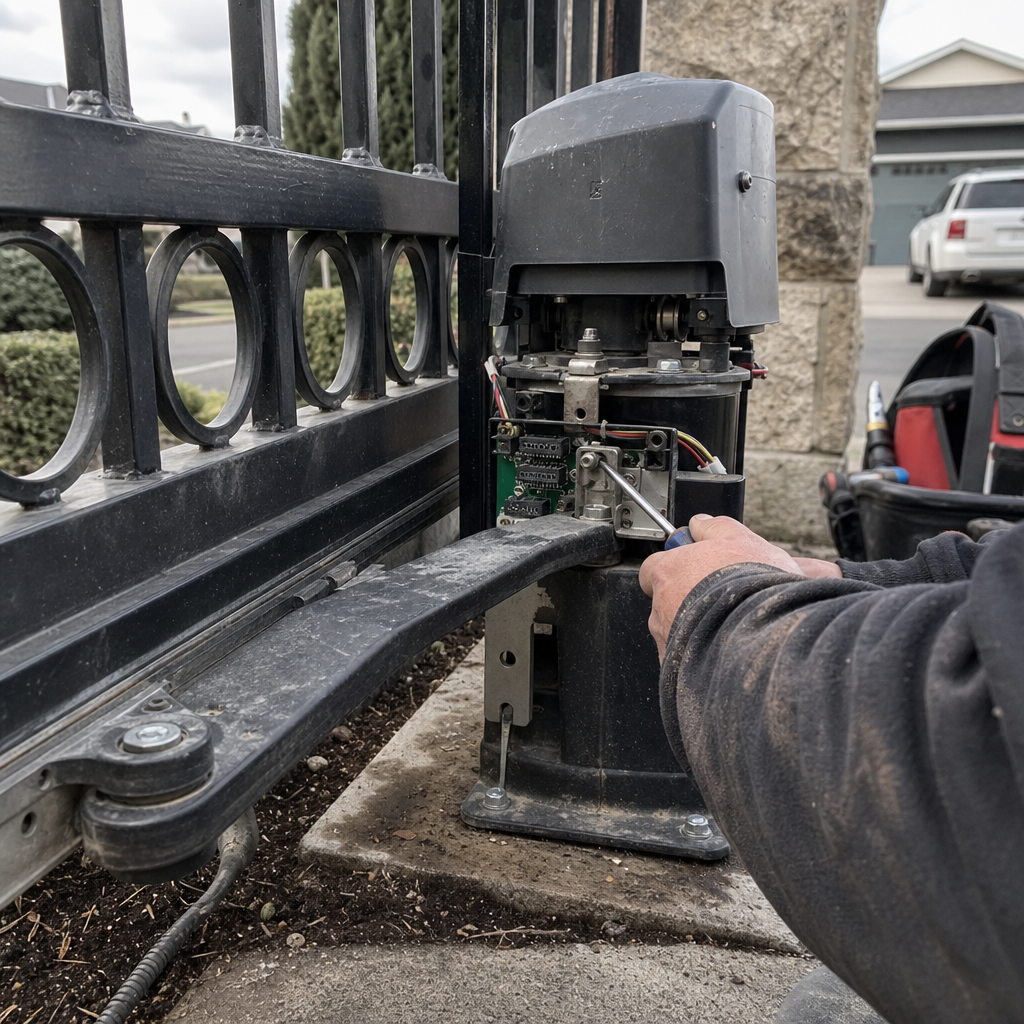
- Replacing a gate motor or opener with a comparable unit in the same location
- Adjusting, repairing, or replacing safety sensors, loops, or access control devices
- Repairing or replacing gate wheels, tracks, or guide rollers
- Repainting, rust treatment, or cosmetic restoration
By contrast, these activities do trigger permit requirements:
- Structural replacement: Installing a new gate leaf or frame where the old one was removed, even if dimensions are similar
- Location change: Moving a gate opening to a different point in the fence line
- Fence line alteration: Extending, reducing, or reconfiguring the fence connected to the gate
- New automation on a previously manual gate: Adding a motor, operator, or automated access control to a gate that was manually operated
- Post replacement below grade: Excavating and replacing gate posts, which affects footing depth and structural load calculations
- Height increase: Raising a gate above its previously permitted height (typically 6 feet in residential zones without variance)
In our 11 years working gates across Vancouver — from the older ranch properties in Hockinson to the newer developments in Fisher’s Landing — we’ve learned that the “comparable unit” exception for motor replacement trips people up most often. If your old Elite or Mighty Mule operator is replaced with a newer model of similar capacity and the same mounting configuration, you’re generally in repair territory. But if you upgrade from a residential swing gate operator to a commercial-grade slide gate system, or change from swing to slide entirely, you’ve crossed into modification territory and need permits.
The Vancouver climate compounds this distinction. Our wet winters and freeze-thaw cycles mean gate posts heave and settle differently than they do in drier regions. A post that “needs replacement” in Vancouver often needs deeper footing than the original 1980s installation provided — and once you’re excavating below 24 inches and pouring new concrete, you’re in structural work territory that inspectors will want to see permitted and documented.
Clark County and City of Vancouver Permit Rules
Clark County and the City of Vancouver operate under slightly different permitting structures, and which jurisdiction applies depends on your property’s location — not your mailing address.
City of Vancouver: Properties within city limits permitting through the City of Vancouver Community Development Department. Residential gate permits for structural work typically run $75–$150 for the base application, with additional fees for electrical inspection if automation is involved. Plan review turnaround is generally 5–10 business days for straightforward residential gate projects.
Clark County (unincorporated areas): Permits through Clark County Community Development. Base permit fees are comparable, but the county’s threshold for “minor repair” versus “alteration” is interpreted more conservatively in practice — we’ve seen county inspectors flag post replacements that city inspectors passed. If you’re in unincorporated Clark County near Vancouver’s edges — areas like Meadow Glade, Brush Prairie, or the rural properties along Northeast 152nd — budget extra time for plan review and expect more scrutiny of footing depths.
Key Vancouver-specific considerations:
- Critical areas: Properties near wetlands, steep slopes, or streams in Vancouver’s Salmon Creek or Lacamas Lake watersheds may trigger additional environmental review even for minor gate work
- Historic districts: The Officer’s Row and Arnada neighborhoods have design review requirements that layer on top of standard building permits
- Fire access: Vancouver Fire Department requires minimum gate opening widths for emergency access — typically 12 feet for single-family driveways, 20 feet for multi-family or commercial — and will comment on permits for new installations
- Side yard setbacks: City code requires gates in side yards to meet the same setback requirements as fences, typically 3–5 feet depending on zoning
The practical reality in Vancouver’s market: most gate service calls we handle are legitimate repairs that need no permit. But when we’re replacing a rotted post on a 1970s estate near Burnt Bridge Creek, or upgrading an old manual gate to automated access for a rental property in downtown Vancouver, we flag the permit requirement before work begins. Starting work without a required permit in Vancouver can result in stop-work orders, doubled permit fees, and — most costly — required removal of completed work to allow inspection.
UL 325 Safety Requirements for Automated Gates in Washington
Here’s the rule that surprises even experienced Vancouver property managers: UL 325 compliance applies to every automated gate in Washington, regardless of when it was installed. There is no grandfather clause for older gates. If your automated gate doesn’t meet current UL 325 standards and someone is injured, your liability exposure is the same as if you installed it yesterday.
UL 325 is the Underwriters Laboratories standard for gate, door, and window operators. It defines the entrapment protection required for all automated gate systems. In Washington, the standard is incorporated by reference into the state electrical code and enforced by local inspectors.
What UL 325 requires for every automated gate:
- Primary entrapment protection: Each automated gate must have at least one of the following — photoelectric sensors (photo eyes), a sensing edge on the leading edge, or a monitored safety loop. For most residential swing gates in Vancouver, this means photo eyes positioned to detect a person or vehicle in the gate’s path.
- Secondary entrapment protection: A second independent safety device. Common configurations include photo eyes plus a sensing edge, or photo eyes plus a monitored loop.
- Force limitation: Gate operators must be set so that stopping force does not exceed specified limits — typically 40 pounds of force for residential applications. This requires proper clutch or electronic force setting adjustment.
- Warning devices: Audible and visible warnings before gate movement, typically a strobe or flashing light and alarm.
- Manual release: Every automated gate must have a clearly identified, accessible manual release mechanism for emergency operation during power failure.
The specific entrapment protection configuration varies by gate type. Slide gates require different sensor placement than swing gates. Bi-parting gates need protection at the center meeting point. Commercial gates with high cycle counts need more robust sensing edges than residential systems.
In our experience with nine major brands — including Ghost Controls and DoorKing systems commonly found in Vancouver residential installations — the UL 325 compliance gap we encounter most often is improper photo eye height or alignment. A photo eye mounted at 18 inches detects a car bumper but misses a child’s tricycle or a pet. The standard requires protection across the full hazard zone, which for most residential gates means either multiple photo eyes at staggered heights or a combination of photo eyes and a sensing edge.
We’ve also found that many older Elite and Mighty Mule installations in Vancouver’s 1990s-era subdivisions lack secondary entrapment protection entirely. The original installer met code at the time with a single set of photo eyes, but current UL 325 requires two independent protective measures. When we service these systems, we document the existing configuration and recommend upgrades — not to upsell, but because the liability exposure falls on the property owner if someone is injured.
How to verify your gate’s UL 325 compliance:
- Check for a UL 325 label on the operator itself — usually inside the housing or on the motor nameplate
- Count the number of independent safety devices: you need two minimum
- Test the photo eyes: block them during gate movement and confirm the gate reverses or stops
- Test force setting: place a solid object (not your body) in the gate path and verify the gate stops before applying excessive force
- Verify the manual release functions and is accessible without tools
If your gate fails any of these checks, it does not meet current Washington safety standards regardless of when it was installed.
HOA Gate Rules: Why the Permit Is Just the Floor
Vancouver has dozens of homeowner associations with gate requirements that exceed city and county code — and violating them can trigger fines, forced removal, or litigation even when your gate is fully code-compliant.
We’ve worked in communities from the gated enclaves near Camas Meadows to the townhouse associations along Southeast Mill Plain, and the pattern is consistent: the HOA architectural committee treats the municipal permit as the minimum standard, not the governing one.
Common HOA overlays in Vancouver:
- Material restrictions: Cedar, wrought iron, or specific aluminum finishes mandated; vinyl or chain-link prohibited even where city code allows them
- Color palettes: Pre-approved earth tones or community-matching schemes; “any neutral” is rarely sufficient
- Height limits below code maximum: City allows 6 feet without variance in many zones; HOAs often cap at 4 or 5 feet for aesthetic consistency
- Automation prohibitions: Some Vancouver HOAs ban automated gates entirely for noise or aesthetic reasons, permitting only manual operation
- Access control specifications: Required keypad models, intercom systems, or visitor management protocols that limit brand choice
- Maintenance and appearance standards: Rust, peeling paint, or sagging that wouldn’t trigger code enforcement can generate HOA violation notices
The critical point for Vancouver homeowners: HOA approval is separate from and in addition to any required permit. We’ve seen homeowners obtain proper city permits, complete installation, and then face HOA demands to remove or modify a fully code-compliant gate because architectural review was never requested. The permit inspection passes; the HOA violation persists.
Before any gate work in a Vancouver HOA community, request the association’s written architectural guidelines and the specific approval process. Most Vancouver-area HOAs require submission of manufacturer specifications, color samples, and site plans before work begins. Starting without approval — even for a repair that needs no city permit — can violate CC&Rs.
What Inspectors Actually Check on Gate Installations
When a Vancouver gate installation does require permit and inspection, understanding what the inspector evaluates helps you prepare documentation and avoid callback inspections that cost time and money.
Structural inspection (building inspector):
- Post depth and footing: Gate posts in Vancouver must typically extend 24–36 inches below grade depending on gate weight and soil conditions, set in concrete of specified minimum dimension. Inspectors measure depth or review photos if the excavation was pre-approved for backfill.
- Post diameter and wall thickness: Must match engineered specifications for gate weight and wind load. We’ve seen inspectors reject 2-3/8 inch residential posts for a heavy wrought-iron gate that required 4-inch commercial-grade posts.
- Gate clearance and swing arc: Must not encroach on setbacks, sidewalks, or utility easements. In Vancouver’s narrower lots, especially in older neighborhoods like Arnada or Hough, this is a common failure point.
- Hardware and latch height: Self-latching mechanisms required for pool-adjacent gates; latch height typically 54 inches minimum for child safety.
- Fire department access: Verification that gate opening width meets Vancouver Fire Department requirements for emergency vehicle passage.
Electrical inspection (L&I electrical inspector):
- Operator listing and labeling: UL 325 label present and legible; operator rated for the gate type and weight
- Safety device function: Photo eyes, sensing edges, or loops tested in real time; inspector will walk through the gate path or place an object to verify response
- Grounding and bonding: Proper equipment grounding conductor; proper bonding of metal gate components in contact with soil
- Disconnect location: Within sight of the operator, accessible, properly labeled
- Conduit and wiring methods: Appropriate for wet location if exposed; proper depth for underground runs
The Vancouver inspection process typically requires two visits: rough inspection before backfill (for post depth verification) and final inspection after completion. Scheduling delays of 1–2 weeks are common during peak construction season. We document every installation we perform with date-stamped photos of post excavation, concrete pour, and safety device placement — this protects the homeowner if questions arise later and expedites re-inspection if an inspector change occurs mid-process.
Liability Exposure of Non-Compliant Automated Gates
The legal landscape for automated gate injuries changed permanently with a series of UL 325-related cases in the early 2000s, and Washington courts have followed the national trend: property owners bear strict liability for automated gate injuries when safety devices are absent or non-functional.
The pivotal case most often cited is Keith v. Buchanan and subsequent product liability actions that established operator manufacturers’ duty to provide compliant safety systems — but critically, did not relieve property owners of their independent duty to maintain those systems. In Washington, premises liability law holds property owners responsible for dangerous conditions they knew or should have known about. A gate with missing photo eyes, a bypassed safety loop, or force settings cranked up to “make it work” creates a known dangerous condition.
Specific liability exposures for Vancouver property owners:
- Personal injury claims: Entrapment, crushing, or strike injuries to visitors, delivery personnel, or children; damages can exceed homeowner policy limits
- Home sale disclosure: Known non-compliance must be disclosed; failure to disclose can trigger post-sale litigation
- Insurance coverage disputes: Some policies exclude claims arising from known code violations or unpermitted work
- HOA and neighbor disputes: Damage to adjacent property from a malfunctioning gate can generate liability if maintenance negligence is established
The documentation gap is where we see Vancouver homeowners most exposed. If your gate was installed before you purchased the property, and you have no record of its safety configuration, you cannot prove compliance if an incident occurs. When we service gates in Vancouver — whether a simple hinge repair on a manual gate or a full operator diagnostic on an automated system — we provide written documentation of safety device presence, function, and any deficiencies found. This isn’t paperwork for paperwork’s sake; it’s evidence of due diligence that protects you in a liability scenario.
How a Technician’s Documentation Protects You
In 11 years and 527 customer interactions across Vancouver, we’ve learned that the technician who fixes your gate today can be your strongest witness — or your weakest link — if compliance questions arise tomorrow.
What proper gate service documentation includes:
- Pre-service condition report: Photographs of existing safety devices, operator labels, and structural condition before any work begins
- Work performed: Specific parts replaced, adjustments made, settings modified — with brand and model numbers
- Post-service safety verification: Confirmation that all required safety devices function after service; force settings measured and recorded
- Compliance assessment: Explicit statement of whether the gate meets current UL 325 and local code, or what deficiencies exist
- Recommendations: Required upgrades versus optional improvements, with risk explanation for each
This documentation serves multiple purposes. For Vancouver homeowners planning to sell, it provides evidence of compliant maintenance to present during buyer inspection. For rental property owners, it establishes a record of due diligence in premises liability defense. For HOA communities, it demonstrates adherence to architectural guidelines beyond the minimum code.
We generate this documentation on every Cardinal Gate Repair Vancouver service call — not because regulations require it, but because Stephen Rogers, as owner and lead technician, is personally accountable for every gate he touches. When you’re the same person answering the phone, performing the work, and signing the invoice, documentation quality isn’t delegated to a junior tech who won’t be there if questions arise later.
The inverse is also true: technicians who won’t put compliance assessments in writing, who “don’t do paperwork,” or who tell you a verbal assurance is sufficient — they’re creating exposure you inherit. In Vancouver’s active real estate market, where gate compliance questions increasingly appear on buyer inspection checklists, written documentation from a identifiable technician with verifiable credentials carries weight that a generic invoice does not.
Common Mistakes to Avoid
- Assuming “repair” covers everything: Replacing a gate post in Vancouver’s wet clay soils often requires deeper excavation than the original, which triggers permit requirements many homeowners miss. Always confirm whether your specific work crosses the repair threshold.
- Ignoring the electrical inspection: Even when a building permit isn’t required for gate work, adding or replacing an automated operator requires electrical inspection in Washington. Skipping it invalidates your compliance.
- Buying a “DIY” operator kit without verifying UL 325: Online marketplace operators often lack proper UL 325 listing for the gate type. We’ve replaced multiple Mighty Mule and Ghost Controls units in Vancouver that were sold as “compatible” but lacked required safety device connections.
- Assuming HOA approval follows city permit: Vancouver’s HOAs operate independently. We’ve seen $8,000 installations ordered removed because architectural review was never requested — after the city permit was properly obtained and final inspected.
- Removing safety devices to “fix” a nuisance: Bypassing photo eyes because they trigger in rain or misaligning sensing edges because they stop the gate too often creates immediate liability. The fix is proper adjustment or replacement, not disabling.
- Failing to document pre-existing conditions: When buying a Vancouver home with an automated gate, request maintenance records and compliance documentation. Without them, you assume liability for unknown deficiencies.
- Using a general handyman for automated gate work: Gate operators are specialized electrical equipment with specific safety requirements. A handyman who “does gates too” rarely carries the brand-specific knowledge to verify UL 325 compliance across LiftMaster, FAAC, BFT, Linear, Viking, Ghost Controls, DoorKing, Elite, and Mighty Mule systems.
When to Call a Professional
Call a qualified gate technician when your project involves any of the following: replacing gate posts or footings; converting a manual gate to automated operation; replacing an operator with a different type or capacity; any work in a Vancouver HOA community requiring architectural review; or when you cannot verify that your existing automated gate has two independent UL 325 safety devices in working order.
For Vancouver homeowners and property managers, gate repair in Vancouver from a specialist who documents compliance protects you beyond the immediate fix. Cardinal Gate Repair Vancouver offers free estimates throughout Vancouver — call (833) 719-7067. Stephen Rogers handles every diagnostic personally, and we carry in-house welding capability and parts inventory for nine major brands, so most repairs complete in a single visit with full documentation provided.
Frequently Asked Questions
No — most gate repairs, including hinge replacement, welding, motor replacement with a comparable unit, and safety sensor adjustment, do not require a permit in Vancouver or unincorporated Clark County. However, structural replacement, location changes, fence line alterations, new automation on a manual gate, and post replacement below grade do trigger permit requirements. Call (833) 719-7067 for a free assessment of whether your specific project needs permitting.
City of Vancouver residential gate permits typically run $75–$150 for the base application, with additional electrical inspection fees if automation is involved. Clark County fees are comparable but may vary for properties in unincorporated areas. The cost of not permitting required work is far higher — retrofit inspections run $400+, and failed inspections can require removal of completed work. Call (833) 719-7067 for an exact quote on your project.
UL 325 is the safety standard for automated gate operators, requiring entrapment protection, force limitation, warning devices, and manual release capability. Every automated gate in Washington must comply regardless of installation date — there is no grandfather clause. If your gate lacks two independent safety devices or proper force settings, it does not meet current standards and creates liability exposure. We verify UL 325 compliance on every service call and document findings in writing.
Yes — HOA architectural guidelines in Vancouver communities operate independently of municipal code and can impose stricter requirements or prohibit gates entirely. City permit approval does not override CC&Rs. Always obtain written HOA approval before starting gate work, even for repairs that don’t require city permits. We’ve seen fully code-compliant installations ordered removed for HOA violations.
Unpermitted gate work in Vancouver typically surfaces during buyer inspection or title review, triggering required retrofit inspection at seller expense. The inspector will verify post depth, structural integrity, and — for automated gates — UL 325 compliance. Deficiencies must be corrected before closing, often with expedited pricing and potential escrow delays. A $75 permit avoided becomes a $1,000+ closing complication.
Qualified gate technicians document their work in writing, specify brand and model numbers for parts installed, test and record safety device function, and provide explicit compliance assessments. They carry verifiable experience with your specific operator brand — not generic “gate experience.” At Cardinal Gate Repair Vancouver, Stephen Rogers provides dated, detailed service reports on every job, with 11 years of brand-specific expertise across nine major manufacturers.
The Bottom Line
Gate permits in Vancouver, WA are straightforward once you understand the repair-versus-replacement threshold — but the consequences of getting it wrong compound at home sale or injury. Most repairs need no permit; structural changes, new automation, and post replacement do. All automated gates must meet UL 325 regardless of age. HOA rules layer on top of city requirements. And documentation from a qualified technician protects you in ways that matter when compliance is questioned. For Vancouver homeowners, the cheapest permit is the one you pull before starting work; the most expensive is the one you discover you needed at the closing table.
Written by Stephen Rogers, Owner & Lead Technician at Cardinal Gate Repair Vancouver, serving Vancouver since 2015.