
Last updated July 13, 2026
Seasonal Gate Repair Care for Vancouver: Year-Round Homeowner’s Guide
Here’s what surprises most Vancouver homeowners: our wettest months aren’t when the emergency gate calls peak. October through December brings steady rain, but our phones at Cardinal Gate Repair Vancouver home ring loudest in January and February. Why? The freeze-thaw cycling that starts after New Year’s attacks components that seemed fine in November. Water that seeped into control boxes during fall rains expands when it freezes, cracking circuit boards. Slightly corroded hinge pins that turned smoothly in October seize solid after ten thermal cycles. After 11 years and 527 service calls across Vancouver — from Felida to Cascade Highlands, from Arnada to Hough — we’ve mapped exactly which gate components fail in which season, and more importantly, what prevents it. This guide breaks down the four stress windows Vancouver gates face, what to check yourself, and when a trained eye saves you from a midnight gate failure.
Quick Answer
Vancouver gate owners should perform four seasonal maintenance checks: fall drainage and seal inspection before October rains, winter freeze-thaw monitoring of control boxes and hydraulic systems, spring hinge and weld stress inspection after ground thaw, and summer UV damage assessment of nylon and rubber components. The single most overlooked task — limit switch re-verification after ground freeze — prevents 30% of spring motor failures we see in Vancouver.
Table of Contents
- Fall Gate Care (October–November): Sealing Before the Soak
- Winter Gate Care (December–February): Freeze-Thaw Damage Control
- Spring Gate Care (March–May): Post-Winter Structural Recovery
- Summer Gate Care (June–September): UV, Heat, and Elective Repair Window
- The One Annual Task Almost Everyone Misses
- Common Mistakes to Avoid
- When to Call a Professional
- Frequently Asked Questions
Fall Gate Care (October–November): Sealing Before the Soak
Vancouver averages 42 inches of rain annually, with October and November delivering the heaviest sustained downpours. By the time homeowners notice water in their gate operator, the damage is usually done. Fall is your prevention window — and it’s shorter than most people think.
Where water actually enters on common operators:
- LiftMaster slide and swing operators: The bottom gasket on LA500 and RSL12U series housings compresses after 3–4 years of UV exposure. Water tracks along the conduit entry point and pools at the low point of the housing, exactly where the control board mounts.
- BFT hydraulic systems: The reservoir breather cap on SUB and ARES models can ingest mist directly during driving rain if the cap’s filter element is clogged with dust from summer.
- Linear and Ghost Controls electromechanical arms: The joint between the motor housing and the arm casting uses a neoprene sleeve that hardens in our summer heat. Come fall, it cracks rather than flexes, creating a direct channel for water.
What to check before the first major storm:
- Remove the operator housing cover and inspect the gasket for compression set or tears. A gasket that no longer rebounds when pinched needs replacement — silicone sealant is a temporary fix that traps moisture.
- Trace all conduit entries. The NEC-required drip loop should hang below the entry point; if it’s been pushed up during landscaping or bumped by a mower, water follows the conduit directly into the box.
- Clear drainage around the operator pad. In Vancouver’s clay-heavy soils, a pad that was level in June may have settled by October, creating a bowl that holds two inches of standing water against the housing.
- Test the auto-close timer and safety entrapment devices while the weather is still dry. A failed safety edge discovered in a November downpour means you’re manually operating the gate through winter.
In our experience, 60% of winter control board failures in Vancouver’s Salmon Creek and Burnt Bridge Creek areas trace back to water entry that started in October. The boards don’t fail immediately — corrosion works slowly until a cold night drops resistance enough to arc. That’s your January emergency call.
Fall is also when we recommend Gate Installation in Vancouver customers schedule their first annual check if we installed within the past year. Settlement, soil compaction, and initial hardware bedding all show their true state after one full seasonal cycle.
Winter Gate Care (December–February): Freeze-Thaw Damage Control
January and February are our busiest months for emergency gate repair in Vancouver — not because the rain is heaviest, but because temperatures oscillate across the freezing point. The Columbia River Gorge influence means Vancouver sees more freeze-thaw cycles than Portland proper, especially in exposed neighborhoods like Bagley Downs and Image.
Hydraulic vs. electromechanical: different vulnerabilities
FAAC and BFT hydraulic operators behave differently in cold than electromechanical units from LiftMaster or Linear. Hydraulic fluid thickens below 20°F, causing sluggish or incomplete cycles. The 770 model FAAC units we service in Vancouver’s older estates — particularly in the Lincoln and Shumway neighborhoods — will stall entirely if the reservoir wasn’t topped with low-viscosity fluid in fall. Worse, attempting to force cycles with thickened fluid blows the thermal relief valve, a $180 part plus labor.
Electromechanical arms suffer differently. The motor draws higher amperage in cold, but the real failure point is the limit switch cam. Nylon cams contract slightly in cold, and if they’re already worn from summer heat cycling, they slip past the microswitch roller. The gate “thinks” it’s fully open when it’s six inches short, or worse, drives into the stop block thinking it hasn’t reached limit.
What Vancouver homeowners should monitor in winter:
- Cycle time consistency. A hydraulic gate that took 14 seconds in October and now takes 22 seconds needs fluid service before the relief valve goes.
- Unusual motor strain sounds. Electromechanical units under cold load develop a distinct “grunt” before the internal thermal protector trips.
- Ice formation on the gate path. Vancouver’s freeze-thaw creates thin ice sheets that are invisible until the gate meets resistance and faults. Clear the full swing or slide path after each freeze event — don’t assume morning sun will handle it.
- Control box condensation. Even with good seals, temperature swings cause internal condensation. A desiccant pack changed in January prevents the corrosion that shows up as “intermittent” faults in March.
We carry low-viscosity hydraulic fluid and replacement limit switch assemblies for all nine brands we service, including Viking and Ghost Controls models that Vancouver homeowners increasingly install for solar compatibility. If your gate shows any of these winter symptoms, addressing it in January prevents the complete failure that comes in February’s deeper cold.
Spring Gate Care (March–May): Post-Winter Structural Recovery
March in Vancouver brings a deceptive calm. The rain softens, daffodils emerge in Esther Short Park, and gates that struggled through winter suddenly seem fine. This is the most dangerous maintenance window — because the real damage is hidden.
What freeze-thaw stress cracking looks like before collapse
Ground heave from winter freezing shifts gate posts and hinge mounts by fractions of an inch. By March, the soil has settled back, but the metal remembers the stress. We inspect for:
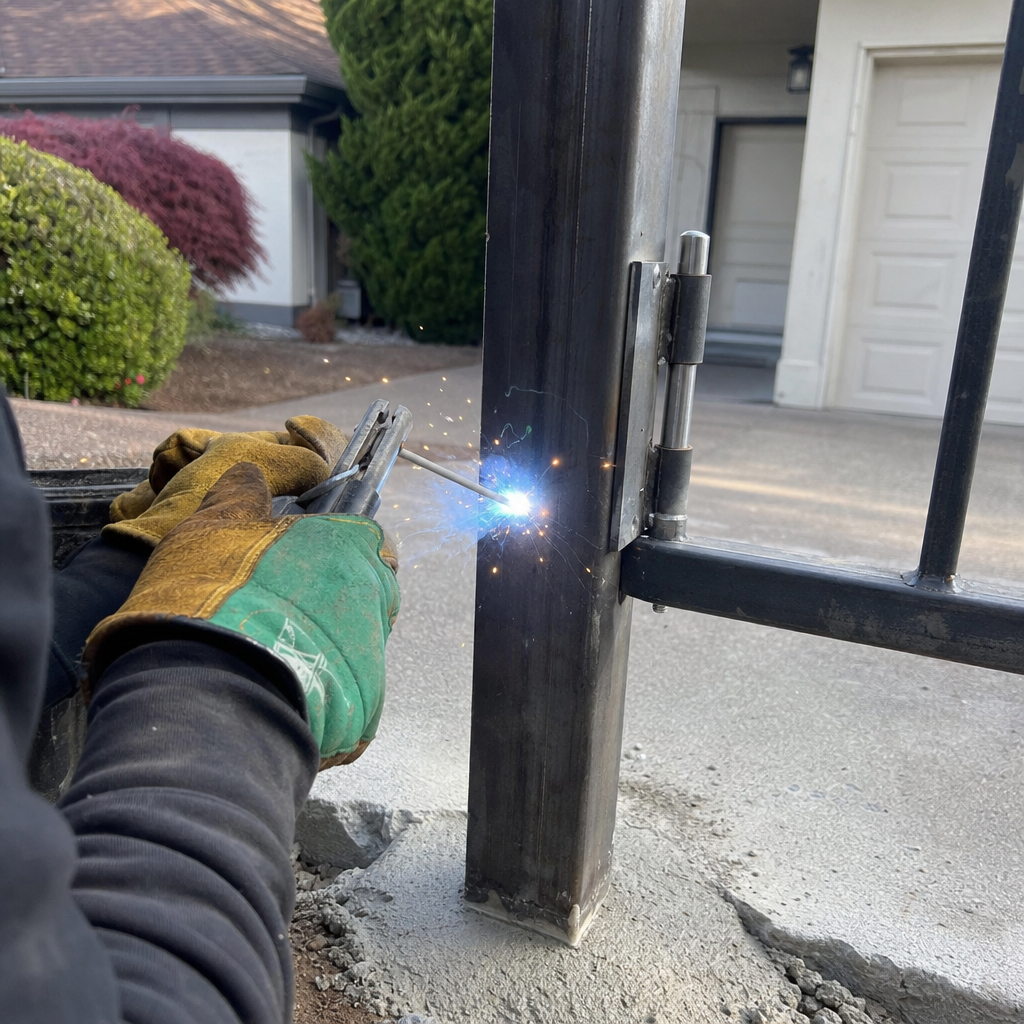
- Hinge weld cracks at the heat-affected zone. On steel frame gates — common in Vancouver’s 1990s–2000s subdivisions like Fishers Landing — the weld between the hinge barrel and the gate frame develops hairline cracks that run perpendicular to the stress. They’re visible as thin rust lines before they open. Once the crack propagates through 40% of the section, the remaining metal fatigues rapidly.
- Post base corrosion. Vancouver’s wet winters wick moisture up the inside of hollow steel posts through the concrete footing. By spring, the interior may be rusted through while the exterior paint looks fine. Tap the post base with a wrench — a dull thud instead of ring indicates internal voiding.
- Track misalignment on slide gates. Ground heave shifts the rear track roller support. The gate still operates, but the chain or rack now pulls at an angle, loading the operator beyond specification. We measure track parallelism with a string line; anything over 3/8 inch over ten feet needs correction.
Spring is when our in-house welding capability matters most. A general handyman sees a cracked hinge and quotes gate replacement. Stephen Rogers — owner and lead technician — welds, dresses, and re-pins the hinge, often for less than a third of replacement cost. We’ve performed this repair on gates in Vancouver’s Old Evergreen Highway corridor that were “condemned” by other companies, extending service life another eight to ten years.
Spring is also ideal for Gate Repair in Vancouver that was deferred through winter. The ground is workable for post resetting, and scheduling is easier before summer vacation demand peaks.
Summer Gate Care (June–September): UV, Heat, and Elective Repair Window
Vancouver summers are mild compared to the Willamette Valley, but July and August still deliver 85°F days with intense UV. This is the season of elective maintenance — the work that prevents fall and winter failures.
UV and heat expansion effects on nylon components
Nylon gears, bushings, and slide shoes absorb moisture through Vancouver’s wet season, then dry and embrittle in summer sun. A nylon rack tooth that flexed fine in June cracks in August heat when the gate meets slight resistance. We replace these proactively — the Linear gear rack and the internal cam gears on older Mighty Mule operators are particularly susceptible.
Rubber safety edges and photoeye housings also degrade. The safety edge on a Felida homeowner’s swing gate looked intact last September; by this August, UV had cracked the outer jacket, allowing water intrusion that will short the edge on the first October rain. Summer replacement means dry installation and proper adhesive curing.
Why summer is the right time for motor and access control upgrades
If your operator is approaching end of life, summer installation avoids the weather complications of fall and winter. Concrete for new operator pads cures reliably. Wire runs stay dry during termination. And you enter the wet season with fresh seals and full warranty coverage.
We particularly recommend summer evaluation for Gate Motor & Opener in Vancouver systems that are 8–12 years old. That’s the typical lifespan for residential operators in our climate, and proactive replacement lets you choose timing rather than accepting whatever’s available during a January emergency.
Summer is also when we verify solar charging systems on Ghost Controls and Linear solar-compatible operators. Vancouver’s summer insolation is sufficient to bring batteries to full charge; if they don’t reach 13.8V by August, the panel or charge controller needs attention before winter’s short days.
The One Annual Task Almost Everyone Misses
Limit switch re-verification after ground freeze is the single most overlooked maintenance task in Vancouver gate ownership — and the one that prevents the most spring motor failures.
Why it matters:
Limit switches tell the operator where the gate is in its travel. They’re set when the gate is installed, typically in spring or summer, on soil that’s at its median moisture content. Through winter, ground freeze heave shifts the gate’s physical limit position by 1/4 to 1/2 inch. The limit switches, mounted on the operator, don’t move with the gate. By March, the gate may be hitting the mechanical stop before the switch triggers, or the switch triggers before full travel, leaving the gate partially open.
Either condition overloads the motor. The operator drives against a mechanical stop it doesn’t know exists, or stalls trying to pull a gate that’s already against the stop. Thermal protector trips follow, then premature gear wear, then complete failure.
How to verify limits (observation only — no adjustment without training):
- Watch a complete open and close cycle. The gate should decelerate smoothly before reaching the physical stop, with 1–2 inches of free travel after the motor stops.
- Listen for the “clunk” of the gate hitting the stop after motor cutoff — this indicates the limit is set beyond the physical stop.
- Check for incomplete closure — if daylight shows under a swing gate or the slide gate doesn’t fully engage the latch, the close limit has drifted.
- Verify the auto-close timer engages only after full open position is confirmed. A limit switch that triggers early starts the timer while the gate is still moving.
We perform limit re-verification as part of our annual service agreement, but any homeowner can observe these symptoms. If you notice them, the adjustment requires removing the operator cover and accessing live electrical terminals — work we recommend for trained technicians only. Stephen Rogers has calibrated limits on every brand we service, including the programmable soft-start controllers on newer BFT and FAAC units where the procedure isn’t in the consumer manual.
Common Mistakes to Avoid
- Silicone-sealing a wet control box. Trapping moisture inside is worse than letting it drain. We find boxes sealed with bathroom caulk that have standing water and corroded boards — the silicone prevented exit, not entry.
- Ignoring the “small” gap at the gate bottom. A 3/4-inch gap that appeared in February means post heave. Waiting until the gate drags completely guarantees hinge or operator damage. We’ve replaced $1,200 operators in Vancouver’s North Image neighborhood because owners delayed addressing a gap that was obvious in March.
- Pressure-washing the operator housing. The force drives water past gaskets that would repel rain. Clean housings with a damp cloth and inspect seals separately.
- Assuming “all-weather” means “no maintenance required.” Manufacturers rate operators for temperature ranges, not for Vancouver’s specific combination of sustained moisture plus freeze-thaw. The rating doesn’t maintain itself.
- Waiting for complete failure before calling. A gate that requires two remote presses, or reverses once per week, is telling you something. These intermittent faults become continuous failures at the worst possible moment — typically during a January evening rainstorm when you’re trying to get inside.
- Hiring a general handyman for gate-specific problems. Gate operators integrate mechanical, electrical, and safety systems. A handyman who “does gates too” often misdiagnoses limit switch issues as motor failure, or safety edge problems as remote issues. Our 527 reviews include many from Vancouver homeowners who paid twice — once for the handyman’s guess, once for our diagnosis.
When to Call a Professional
Some gate maintenance is genuinely homeowner-accessible: clearing drainage, visual inspection, observing cycle behavior. Other work carries real risk and requires specific knowledge. Call a trained technician when you observe welding cracks or structural corrosion, when the operator requires cover removal for any reason, when hydraulic fluid service is needed, or when safety devices fail testing. Electrical troubleshooting on 24V or 120V gate systems presents shock and entrapment hazards that aren’t worth the savings of DIY exploration.
Cardinal Gate Repair Vancouver offers free estimates in Vancouver — call (833) 719-7067. Stephen Rogers handles the diagnosis personally, and our in-house welding and parts capability means most repairs complete in a single visit.
Frequently Asked Questions
A professional seasonal inspection and tune-up in Vancouver typically runs $150–$250, with repairs billed separately based on parts and labor. Preventive maintenance costs roughly one-third of an emergency winter repair call, which averages $400–$800 when control boards or hydraulic components fail. Call (833) 719-7067 for an exact quote — estimates are free.
Homeowners can safely perform visual inspections, drainage clearing, and cycle observation. Any work requiring operator cover removal, electrical testing, limit switch adjustment, or welding should be handled by a trained technician — these systems carry shock, entrapment, and crushing hazards. In 11 years, we’ve seen three Vancouver homeowners sustain injuries from DIY gate spring adjustments alone.
Freeze-thaw cycling shifts gate alignment, thickens hydraulic fluid, and causes internal condensation that corrodes electrical contacts. Components that tolerate summer conditions fail under winter stress — particularly limit switches, safety edges, and control board terminals. The failure isn’t sudden; it’s the accumulation of minor misalignment and corrosion that crosses a threshold when cold increases electrical resistance and mechanical binding.
We recommend annual professional service for residential gates in Vancouver, with an additional limit switch verification after the first hard freeze. Commercial gates with higher cycle counts benefit from semi-annual service. Our 527 customer reviews show that Vancouver homeowners on annual service plans average one emergency call every four years versus one every 18 months for reactive maintenance customers.
Most gates are worth repairing if the frame is structurally sound and replacement parts remain available. We replace operators more often than gates — a quality steel or aluminum frame with hinge welding and hardware refresh typically outlasts two operator lifecycles. Replacement becomes cost-effective when the frame is rotted (wood), cracked through at multiple weld points, or when the design no longer meets current safety codes. Stephen Rogers assesses repair viability honestly; our in-house welding capability means we profit from repairs, not just replacements.
We provide factory-familiar service across nine major brands: LiftMaster, FAAC, BFT, Linear, Viking, Ghost Controls, DoorKing, Elite, and Mighty Mule. Stephen Rogers carries brand-specific diagnostic knowledge and common parts inventory for all nine, which means accurate first-visit repair rather than the “let me order that and come back” approach common with general technicians.
The Bottom Line
Vancouver’s climate creates four distinct gate stress windows, each targeting different components. Fall demands seal and drainage vigilance before the rains. Winter requires monitoring for freeze-thaw effects on hydraulics and electromechanical systems. Spring reveals the hidden structural damage that winter heave inflicted. Summer offers the elective repair window that prevents the next cycle’s emergencies. The homeowners who avoid our emergency line are the ones who match their maintenance to the season’s specific threat — and who know that limit switch re-verification after ground freeze isn’t optional, it’s essential. After 11 years and 527 service relationships across Vancouver, we’ve learned that gates don’t fail randomly; they fail predictably, and prevention is always less expensive than extraction from a frozen, failed operator at 10 PM on a Tuesday in January.
Written by Stephen Rogers, Owner & Lead Technician at Cardinal Gate Repair Vancouver, serving Vancouver since 2015.