
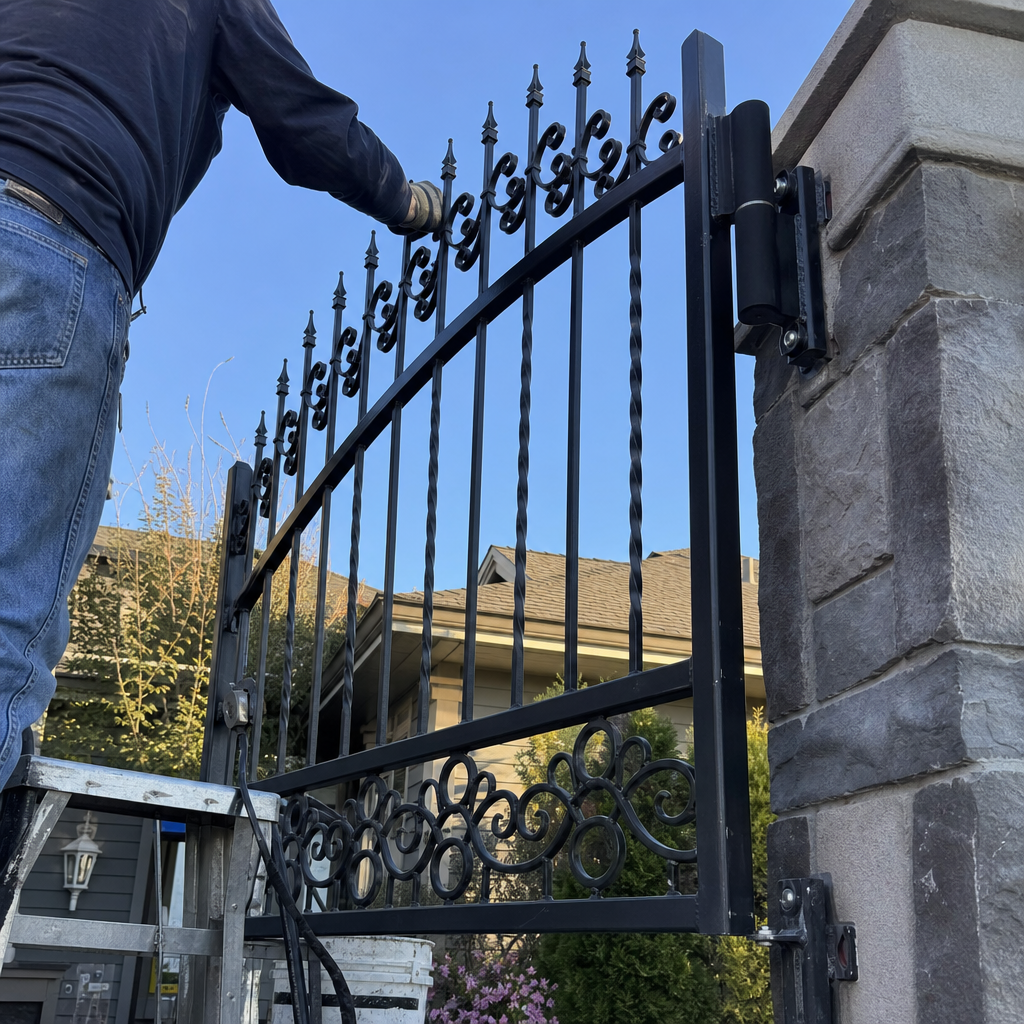
Why Is My Gate Motor Not Working in Vancouver, WA? The Most Common Cause Costs $90 to Fix — If You Diagnose It Right
Your gate motor is probably not working because the control board has failed, not the motor itself. In Vancouver’s exposed locations — especially east-facing properties in Salmon Creek, Felida, and along the SR-502 corridor — wind-driven rain from Columbia River Gorge events forces water into the operator housing, corroding the circuit board while the motor windings stay perfectly fine. The motor isn’t dead; it’s just not receiving instructions. The difference between replacing a control board ($180–$340 installed) and an unnecessary full motor replacement ($550–$900) comes down to whether your technician opens the housing and tests the components separately. If you’re stuck outside your gate right now, call Cardinal Gate Repair Vancouver at (833) 719-7067 — we carry replacement boards for LiftMaster, Viking, and FAAC units and can usually diagnose this on-site same-day.
The Vancouver Climate Failure Nobody Talks About: Gorge Wind + Rain Infiltration
Generic troubleshooting guides tell you to check the remote battery and the breaker. That’s fine for Phoenix or Sacramento. In Vancouver, WA, we have a different dominant failure mode that destroys control boards while leaving motors untouched — and it costs homeowners hundreds when misdiagnosed.
Here’s what happens: when east winds channel through the Columbia River Gorge and slam into Vancouver at 40–70 mph, they don’t just rattle your gate. They force rain horizontally into every seam and vent on exposed gate operator housings. Above-ground swing operators — the kind mounted on posts near the gate leaf — are especially vulnerable when they face east or northeast. The water pools on the board, corrodes traces and relays, and eventually shorts the low-voltage control circuitry. The motor itself, sealed in its own housing, tests fine on a bench. But without a functioning board, it might as well be a boat anchor.
Stephen Rogers — owner and lead technician at Cardinal Gate Repair Vancouver — opened a dead Mighty Mule operator last March on a property near Orchards after a three-day Gorge wind event. The motor windings showed 2.1 ohms, well within spec. The control board had green copper corrosion across the relay contacts and a burned trace where moisture had bridged a 24V logic line to ground. New board, $127 part cost. Full motor replacement would have run $680. That’s the diagnosis gap we’re talking about.
The brands we see most affected by this in Vancouver:
- LiftMaster — LA500 and CSW24 series arm operators; vent design on older units allows direct water intrusion when wind hits at 45+ degrees
- Mighty Mule — FM500 and FM502 post-mounted units; housing seal degrades after 4–6 years in our wet cycles, and the board sits low in the enclosure
- FAAC — 415 and 422 swing operators; Italian-designed venting assumes Mediterranean rainfall angles, not Gorge-driven horizontal rain
Elite operators tend to fare better — their board mounting is vertical and higher in the housing — but even those fail if the gasket hardens and the drain holes clog with debris from Vancouver’s heavy pollen and leaf-fall seasons.
How to Tell Board Failure from Motor Failure: Stephen’s Three-Step Field Check
Before we open any housing, Stephen Rogers runs the same diagnostic sequence he’s refined over 11 years across Clark County. You can do these three checks yourself and report the findings when you call — it’ll speed our response and help us bring the right parts.
Step one: Visual indicator check. Look at the operator housing for any LED status light, digital display, or error code window. A completely dark unit with no response to remote or keypad usually means power supply or control board failure — the board isn’t even reaching its boot sequence. A flashing code (LiftMaster flashes are diagnostic; count them) means the board is alive but detecting a fault condition. Write down the pattern.
Step two: Manual release and mechanical resistance test. Disengage the operator using the manual release handle (usually a pull-cord or lever — check your manual for location). Try moving the gate by hand. Heavy resistance or binding means a mechanical problem — track obstruction, hinge corrosion, or post shift from freeze-thaw — not a motor problem. Smooth manual operation points to electrical or control failure.
Step three: Power supply verification. Check that the outlet or hardwired junction feeding the operator has proper voltage. In Vancouver’s older neighborhoods — Fruit Valley, Garrison, Lincoln — we’ve seen underground conduit fills with groundwater after heavy rains, corroding connections and dropping voltage below the operator’s tolerance. A motor won’t run on 95V when it needs 115V, but the symptom looks identical to motor failure.
Safety note: These checks involve live electrical components and potentially high-tension gate mechanisms. Do not open the operator housing or attempt internal testing. Capacitors inside gate operators can hold lethal charge even when unplugged. If you’re not comfortable with any step, stop and call a professional.
When Stephen arrives, he’ll separate the motor from the control board and test each independently. That’s the difference between a $90 control board repair and a $600 unnecessary motor swap. “Tell me the symptom, I’ll tell you the part — no guessing, no upselling.”
The Four Failure Points Inside Every Gate Operator: What Each One Costs to Fix
Most homeowners — and too many general handymen — treat a gate operator as a single black box. It’s not. Four distinct systems can fail, each with its own symptoms and cost profile:
| Component | Typical Failure Symptom | Common Cause in Vancouver | Repair Cost Range |
|---|---|---|---|
| Power supply / transformer | Completely dead, no lights, no response | Underground conduit corrosion; outlet failure; surge from Gorge wind power fluctuations | $120–$220 |
| Control board / logic module | Dead or erratic behavior; error codes; works intermittently | Wind-driven rain infiltration; capacitor aging in humid cycles | $180–$340 |
| Motor / gearbox assembly | Grinding noise; overheating; runs but doesn’t move gate | Worn brushes; gear lubrication breakdown; physical obstruction damage | $340–$680 |
| Wiring harness / limit switches | Gate stops short; reverses unexpectedly; won’t reach full open/close | Freeze-thaw post movement; rodent damage; connector corrosion | $90–$240 |
The critical insight: a motor that “doesn’t work” is often a control board that won’t let it work, or a limit switch that tells the board the gate is already where it should be. We’ve seen Viking operators in Felida subdivisions where the gate had shifted 3 inches on its post from winter freeze-thaw, moving the physical stop point past the programmed travel limit. The motor was fine. The board was fine. The limit switch was telling the truth about a gate position that no longer matched reality. Recalibration and post adjustment: $180. Full operator replacement quoted by another company: $1,200.
Vancouver’s Freeze-Thaw Battery Backup Failure: The Hidden Winter Kill
Here’s a failure mode that hits Vancouver harder than Portland or Seattle: lead-acid battery backups in gate operators die every winter, and in some brands, a dead backup battery prevents the unit from starting even on shore power.
LiftMaster LA500 and Viking G-5 operators commonly require battery presence for control board initialization — it’s a safety design, ensuring the unit can complete a cycle during power outage. But Vancouver’s freeze-thaw cycles degrade lead-acid batteries fast. A battery that tested fine in October can read 4V by January. The board detects insufficient backup voltage and refuses to boot. The motor isn’t working because the system won’t turn on, not because the motor failed.
We’ve replaced dozens of these in north Vancouver HOA communities along SR-502 and SR-503, where ornamental aluminum driveway gates from the 2005–2012 building boom are all hitting their first battery replacement cycle simultaneously. The symptom is identical to a dead motor: no response, no lights, complete silence. The fix is a $45–$75 battery and a 10-minute reset procedure — if you know to check it.
Pro tip from 11 years in Clark County: if your operator failed after the first hard freeze of winter, suspect the battery before you suspect the motor. Test voltage at the battery terminals with the unit unplugged. Below 10.5V on a 12V battery means replacement. If you’re not comfortable working around electrical components, call us — we stock batteries for all nine brands we service.
When Post Movement Masquerades as Motor Failure
This one frustrates homeowners because it feels like the motor is dying — slow operation, stopping mid-cycle, reversing for no reason — when the motor is actually working too hard against a gate that’s no longer aligned.
Vancouver’s wet winters and clay-heavy soils create perfect conditions for post heave and lean. A swing gate post that was plumb in September can tilt 2–3 degrees by March. The gate still moves, but the operator arm now fights lateral binding through every cycle. The motor draws excess amperage, overheats, and eventually faults out on thermal overload. Replace the motor and the new one fails the same way in six months.
Stephen Rogers checks post plumb and hinge alignment before quoting any motor replacement. Our in-house welding capability means we can fabricate and install post brackets, gusset plates, or even pour new concrete piers without outsourcing. From the motor to the hinge — we cover the entire gate, not just one component.
We’ve seen this especially in mid-century ranch neighborhoods near Fruit Valley and Lincoln, where original wood posts have rotted at the concrete interface after 40+ years of ground moisture. The gate motor “wasn’t working” because it was trying to push a gate through 30 pounds of hinge resistance that didn’t exist when the post was new.
FAQs
Most gate motor repairs in Vancouver run $180–$340 for control board or electrical fixes, $340–$680 for motor or gearbox replacement, and $90–$240 for wiring or limit switch repairs. The exact cost depends on which of the four internal components has actually failed — we diagnose before quoting, not after selling. Call (833) 719-7067 for a free on-site estimate with no pressure to proceed.
Yes, we carry replacement control boards, batteries, and common wiring components for LiftMaster, Viking, FAAC, and other major brands on our service truck, and Stephen Rogers handles diagnostic calls personally as lead technician. Same-day repair is available throughout Vancouver, Salmon Creek, Felida, and Orchards when you call before 2 PM. Emergency service for security-critical situations is also available — call (833) 719-7067 to check current availability.
Repair is almost always cheaper if the motor windings and gearbox are intact — which they are in roughly 70% of “dead motor” calls we see in Vancouver. Control board replacement ($180–$340) versus full operator replacement ($550–$900+) is the most common decision point. We test the motor independently before recommending replacement, and our in-house welding and parts capability means we can often repair components others would swap. If you’d like an honest assessment of whether your unit is worth fixing, call (833) 719-7067 for a free estimate.
Intermittent operation usually means a control board with moisture damage, a failing capacitor, or a limit switch that’s detecting phantom obstructions. In Vancouver, wind-driven rain infiltration is the most common cause — the board works when dry, faults when humidity spikes. Temperature-sensitive failures often trace to cracked solder joints or a battery that’s weak enough to fail under load but reads normal at rest. Intermittent problems are actually harder to diagnose than complete failures because the component tests fine in the shop; we use field logging and load testing to catch them. Call (833) 719-7067 and describe the pattern — we can often narrow it down before arriving.
What to Do Right Now If Your Gate Motor Won’t Work
Start with Stephen’s three-step check above — indicators, manual release, power supply — and note what you find. That information gets us to your door with the right parts instead of making a second trip. If you’re not comfortable with electrical checks, or if your gate is security-critical tonight, skip straight to calling.
Cardinal Gate Repair Vancouver has diagnosed and repaired gate motors across this city for 11 years — from the aging ranch properties near downtown to the HOA-governed subdivisions along SR-502 and SR-503 where matching existing finishes matters. Stephen Rogers, owner and lead technician, handles every diagnostic personally. We work on Gate Motor & Opener systems specifically, not gates in general, and we carry the parts and welding capability to fix what others replace.
527 customers and 11 years later, here’s what we’ve learned: the motor usually isn’t the problem. The diagnosis is.
If your gate motor isn’t working and you’d rather have it looked at by someone who’ll tell you exactly which part failed and why, Cardinal Gate Repair Vancouver offers a no-pressure assessment in Vancouver — call (833) 719-7067.
Written by Stephen Rogers, Owner & Lead Technician at Cardinal Gate Repair Vancouver, serving Vancouver, WA.