
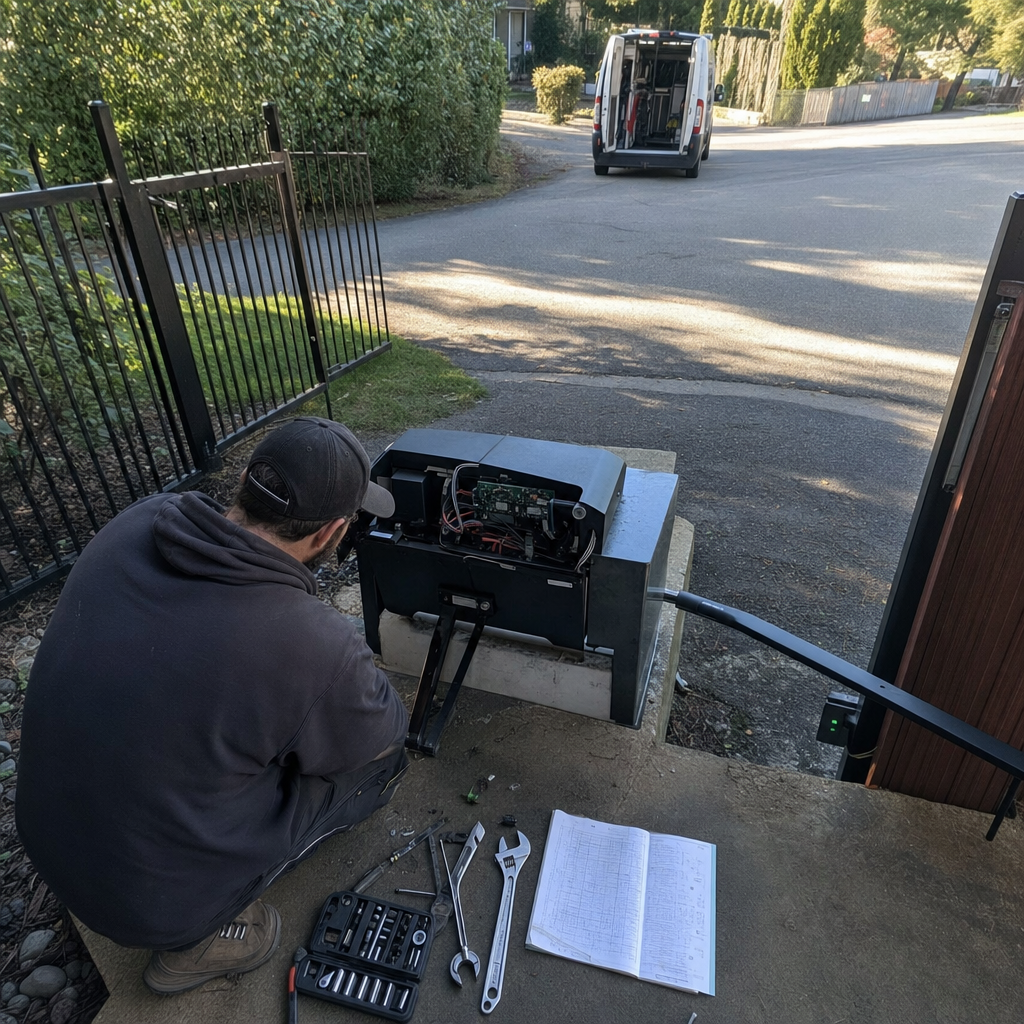
How an Automatic Gate Opener Works in Vancouver, WA: Four Systems, One Gate, and Why Gorge Winds Break Them All at Once
An automatic gate opener is a coordinated assembly of four interdependent systems: a motor that converts electrical energy into mechanical motion, a control board that interprets commands and sensor data, safety sensors that detect obstructions and misalignment, and a mechanical linkage of arms, hinges, or tracks that physically moves the gate. In Vancouver, these four systems rarely fail independently — instead, the Columbia River Gorge’s powerful east winds apply lateral stress to the mechanical linkage, which then triggers cascading faults through the control board and safety sensors, making a single weather event look like multiple system failures. If your gate is reversing randomly, stopping mid-travel, or not responding to remotes, the root cause is often mechanical stress masquerading as electrical failure — and that’s where most general repair calls go wrong. See Why Is my Gate Motor Not Working? (Vancouver, WA) for a deeper breakdown of these symptoms. For a fast diagnosis, call Cardinal Gate Repair Vancouver at (833) 719-7067; Stephen Rogers, our owner and lead technician, handles every assessment personally.
Why Vancouver’s Gorge Winds Create a Unique Failure Pattern
Vancouver sits at the western mouth of the Columbia River Gorge, and that geography isn’t just scenic — it’s mechanical. When east wind events channel through the Gorge and hit Vancouver, they gust 40–70 mph and apply a repetitive lateral load cycle that gates in Portland proper or Gresham simply don’t experience. We’ve spent 11 years tracking the failure patterns across Clark County, and the data is consistent: hinge fatigue, post lean, and automatic opener arm failure dominate our repair calls, not random electrical burnout or simple rust.
Here’s how the cascade plays out on a typical swing gate in Felida or Salmon Creek. The Gorge wind pushes the gate leaf sideways, stressing the hinge and slightly twisting the opener arm. The control board — say, a LiftMaster LA500 or a FAAC 422 — detects that the motor is drawing more current to complete its travel cycle. It interprets this as a potential obstruction and triggers its safety reverse. The owner sees a gate that “reverses for no reason” and assumes the opener is malfunctioning. A general handyman might replace the control board or the motor, when the actual problem is a $12 hinge pin that’s worn oval from wind load, or a post that’s shifted 3/8 inch in freeze-thaw cycles.
We see this exact misdiagnosis regularly in the 1990s–2010s tract developments along the SR-502 and SR-503 corridors, where vinyl privacy gates and ornamental aluminum driveway gates are now hitting their first major repair cycle simultaneously. The Gate Motor & Opener systems in these subdivisions are often Mighty Mule or Elite units installed by the original builder, and they’re failing not from age alone but from the accumulated lateral stress of a decade of Gorge wind events that their original installers never accounted for.
The Four Systems: How They Actually Function
The Motor: From Electricity to Motion
The motor is the muscle. On a swing gate, it’s typically a 12V or 24V DC motor housed in an operator arm — brands like LiftMaster use articulated arms for single-leaf gates, while Viking slide operators use a rack-and-pinion or chain-drive motor that pulls the gate along a track. The motor doesn’t just run at full speed; it’s controlled by the board to ramp up, maintain travel speed, and decelerate before the stop point. This ramping protects the mechanical components and prevents the gate from slamming open or closed.
In Vancouver’s wet climate, motor housings are vulnerable to wind-driven rain infiltration, especially on exposed installations in north Vancouver’s HOA-governed subdivisions. We’ve opened DoorKing operators that had standing water in the lower housing from a single failed gasket — the motor itself was fine, but the moisture had corroded the encoder contacts, causing erratic speed control. That’s a repair, not a replacement, but only if the technician knows to check the housing seal before quoting a new motor.
The Control Board: The Gate’s Brain and Its Limits
The control board receives input from remotes, keypads, vehicle loops, and intercoms, then manages motor output based on programmed travel limits and real-time sensor feedback. Every major brand handles this differently. LiftMaster boards store force profiles — they learn how much current the motor draws during normal operation and flag deviations. FAAC and BFT units use encoder-based position tracking with adjustable sensitivity for obstruction detection.
The critical detail most owners miss: these boards are calibrated to a specific mechanical condition at the time of installation. When a Vancouver freeze-thaw cycle shifts a post even slightly, or when Gorge winds gradually fatigue a hinge, the motor’s current draw changes. The board doesn’t know why — it only knows the profile is wrong. A gate that once opened smoothly now “stutters” or reverses because the board is doing exactly what it was programmed to do: protect against what it interprets as an obstruction.
This is where our in-house welding and parts capability matters. In Fruit Valley or the Garrison neighborhood, where mid-century ranch gates often still run on original steel hardware, we can fabricate a replacement hinge pin or weld a cracked bracket on-site rather than replacing the entire operator assembly. The board gets recalibrated to the repaired mechanical condition, and the “electrical” problem disappears.
Safety Sensors: When “Too Sensitive” Is Actually Correct
Every automatic gate opener sold in the U.S. must include entrapment protection under UL 325 standards. The two primary methods are photo-eye beams (infrared across the gate opening) and inherent force detection (current monitoring by the control board). Photo-eyes are straightforward: break the beam, the gate reverses. But force detection is where Vancouver’s conditions create the most confusion.
LiftMaster operators allow force adjustment in percentage increments — typically 15–30% for residential swing gates. FAAC units use a “sensitivity” dial that correlates to encoder pulse deviation. BFT systems have a similar parameter called “obstacle detection level.” When we get a call from an Orchards homeowner saying their gate “reverses for no reason,” our first check isn’t the board — it’s the mechanical linkage. A dragging hinge, a post that’s leaned 1/4 inch, or an arm that’s bent from wind load all increase resistance. The sensor system reads that resistance as an obstacle and reverses. Turning down the sensitivity might seem like a fix, but it’s actually disabling a safety system that’s correctly detecting a mechanical problem.
We’ve seen this exact scenario on a Viking slide operator in Lincoln: the gate would complete 80% of its travel, then reverse. The previous service had adjusted the obstacle detection to maximum tolerance. The real issue was a track section where freeze-thaw ground movement had created a 1/2-inch vertical offset. The gate wheel was binding, resistance spiked, and the safety system did its job. We welded a track support, realigned the section, and returned the sensitivity to factory spec. Problem solved, safety intact.
The Mechanical Linkage: Where Vancouver’s Climate Does Its Damage
The mechanical linkage — arms, hinges, tracks, rollers, and posts — is where electrical and electronic systems meet physical reality. It’s also where Vancouver’s unique climate conditions concentrate their attack. We’ve identified three distinct failure modes:
- Gorge east-wind lateral load: Swing gate arms, especially on single-leaf installations, act as levers that transfer wind force directly to the hinge and opener mounting bracket. Over time, this elongates bolt holes, cracks welds, and bends arms. We see this most on ornamental aluminum gates in Salmon Creek and Felida, where the gate leaf itself is light but presents a large surface area to the wind.
- Freeze-thaw post movement: Concrete gate posts in Vancouver’s wet, winter-freeze cycles heave and settle differentially. A post that was plumb in October can lean 1/2 inch by March. This throws off gate alignment, increases opener arm binding, and eventually causes the control board to fault. In established neighborhoods near downtown — Fruit Valley, Garrison — original wood posts rot at the ground line from sustained moisture, creating the same alignment failure.
- Rain infiltration into control housings: Wind-driven rain finds gasket failures, cable entry points, and ventilation slots. We’ve replaced control boards in Elite and Mighty Mule operators where the board was literally corroded green, yet the motor and mechanical linkage were pristine. The owner had been quoted a complete replacement; we replaced the board, sealed the housing, and saved them roughly $1,200.
Swing vs. Slide: How Gate Type Changes the Failure Pattern
The physics of your gate type determines which system fails first under Vancouver’s conditions. We work on both, but the diagnostic path differs significantly.
Swing gates — common in mid-century neighborhoods and ornamental installations — use an operator arm that pushes or pulls the gate leaf through an arc. The arm is vulnerable to lateral load because it acts as a cantilever: wind pushes the gate, the arm resists, and the mounting bracket or hinge takes the stress. LiftMaster LA500 and FAAC 422 systems are the dominant brands we see on Vancouver swing gates. When these fail from wind load, the symptoms are arm bending, bracket cracking, or hinge elongation — all mechanical issues that present as “the opener doesn’t work.”
Slide gates — standard for commercial properties and increasingly common in north Vancouver’s larger residential lots — run on a track with a motor-driven carriage. They’re more tolerant of lateral wind load because the track constrains the gate’s movement path. However, they’re sensitive to debris accumulation, track misalignment from ground movement, and roller wear. Viking slide operators are our most common repair in this category; their rack-and-pinion drive is robust, but the nylon rack strips degrade in UV exposure, and the track alignment tolerances are tight enough that 1/4 inch of post shift causes binding.
The access control layer adds another diagnostic dimension. A swing gate that doesn’t respond to the remote but works fine from the keypad tells us the receiver module is likely failed — common after rain infiltration in DoorKing systems. A slide gate that doesn’t respond to either but shows power at the operator suggests a control board fault, often from a surge during a wind-driven outage. These distinctions matter because they change what we bring to the job and what the repair costs.
Access Control: The Signal Path Most Technicians Ignore
The opener doesn’t operate in isolation. It receives commands through multiple input channels, and understanding the signal path is essential to diagnosing “the gate won’t open” calls.
Here’s the typical hierarchy: remote transmitters send radio frequency signals (usually 310 MHz, 315 MHz, or 390 MHz depending on brand) to a receiver module, which passes a dry contact closure to the control board. Keypads hardwire directly or communicate via low-voltage signal. Vehicle loops use inductive detection that triggers when metal mass disrupts the loop’s magnetic field. Intercoms and telephone entry systems add an authorization layer before the board receives any command.
In Vancouver’s wet environment, receiver modules are a common failure point. We’ve replaced LiftMaster 850LM receivers that had corroded antenna connections from condensation cycling, and Elite receiver boards where the coaxial antenna cable had degraded at the housing penetration. The symptom is consistent: keypad works, remote doesn’t, or vice versa. A technician who doesn’t understand the signal path replaces the entire operator; we replace the $45 receiver module and reseal the housing.
Vehicle loops present their own Vancouver-specific challenge. Freeze-thaw ground movement fractures loop wire, and the inductive signature becomes intermittent. The loop detector flags this as a constant “vehicle present” signal, which locks the gate in its current position — a safety default that looks like a dead opener to the owner. We’ve traced this in commercial installations along Mill Plain and in the industrial areas near the Port of Vancouver. The fix is loop replacement or splicing, not operator replacement.
What Repair vs. Replacement Actually Costs in Vancouver
After 527 customer reviews and 11 years of tracking our invoices, here’s what Automatic Gate Opener Installation Cost in Vancouver, WA looks like in our actual service data. These are real ranges from our completed jobs — not estimates, not bait-and-switch opening numbers.
| Service | Typical Range | What Drives the Price |
|---|---|---|
| Control board replacement (LiftMaster, FAAC, BFT) | $340–$580 | Brand, housing condition, whether recalibration reveals secondary mechanical issues |
| Motor/gearbox repair or replacement | $420–$760 | Swing arm vs. slide carriage, brand parts availability, welding required |
| Safety sensor realignment or replacement | $85–$195 | Photo-eye only vs. full force-recalibration after mechanical repair |
| Mechanical linkage repair (hinge, arm, bracket welding) | $180–$440 | In-house welding vs. fabricated replacement, post reset required |
| Receiver module or access control input repair | $125–$280 | Module replacement vs. wiring diagnosis, antenna re-routing |
| Full operator replacement with new install | $1,800–$3,400 | Single swing vs. dual swing vs. slide, concrete work, access control integration |
Our approach — repair first, replace only when necessary — is born from having Stephen Rogers on every job with welding equipment and brand-specific parts knowledge. We’ve saved Vancouver homeowners thousands by fixing a hinge or welding a bracket instead of defaulting to a full operator swap. That said, there are legitimate replacement scenarios — see our guide to the Best Gate Motor & Opener in Vancouver, WA — including a 15-year-old Mighty Mule with obsolete parts, or a gate where the original installer undersized the operator for the gate weight and wind load. When replacement is the right call, we’ll tell you exactly why and show you the math.
FAQs
Your gate is almost certainly reversing because its safety system is correctly detecting abnormal resistance, not because the opener is broken. In Vancouver, the most common cause is Gorge wind stress or freeze-thaw post shift creating mechanical binding that the control board interprets as an obstruction. Before adjusting sensitivity or replacing the board, the mechanical linkage needs inspection — hinge wear, arm alignment, and post plumb are the usual culprits. Call (833) 719-7067 and we’ll diagnose the actual cause; estimates are free.
Most automatic gate opener repairs in Vancouver fall between $180 and $580, with simple sensor realignments at the low end and control board or motor work at the higher end. Full operator replacement runs $1,800–$3,400 depending on gate type and access control integration. The key variable is whether your technician diagnoses the root cause or replaces components until something works — our repair-first approach, with in-house welding and brand-specific parts, typically costs 40–60% less than replacement-quoting competitors. For an exact quote on your system, call (833) 719-7067.
We complete roughly 70% of Vancouver gate opener repairs on the first visit because Stephen Rogers, our owner and lead technician, arrives with parts for the nine brands we specialize in — LiftMaster, FAAC, BFT, Linear, Viking, Ghost Controls, DoorKing, Elite, and Mighty Mule — plus welding equipment for mechanical repairs. Same-day service depends on part availability for your specific model and the complexity of any structural issues. For fastest response, call (833) 719-7067 with your gate type and symptoms; we’ll tell you immediately if it’s a same-day fix.
Repair is cheaper in roughly 80% of the cases we see in Vancouver, especially when the issue is mechanical (hinge fatigue, arm binding, post shift) rather than a failed control board or motor. Even with board or motor failure, individual component replacement typically costs $340–$760 versus $1,800–$3,400 for full replacement. We recommend replacement only when the operator is obsolete with no parts availability, was originally undersized for your gate weight and wind load, or has multiple cascading failures that make repair uneconomical. We’ll show you both options with real numbers — call (833) 719-7067 for a no-pressure assessment.
When to Call a Professional — and What to Expect
Automatic gate openers involve high-tension springs, heavy gate leaves, and 120V electrical supply. We don’t recommend DIY diagnosis beyond basic checks: verify power at the outlet, clear visible debris from the track, and test multiple input methods (remote, keypad, manual release) to narrow whether the issue is power, signal, or mechanical. Beyond that, the interdependence of the four systems means a misdiagnosis can lead to unnecessary parts replacement or, worse, disabling a safety system that protects vehicles and pedestrians.
When you call Cardinal Gate Repair Vancouver, Stephen Rogers handles your gate personally — from the phone call to the site assessment to the repair itself. We don’t send rotating subcontractors or call-center dispatchers. Our truck carries parts and welding capability for the nine major brands, which means most repairs complete in one visit without waiting for ordered components.
Tell me the symptom, I’ll tell you the part — no guessing, no upselling.
If your automatic gate opener is acting up — reversing, stalling, not responding, or making noises it didn’t make last season — we’re happy to take a look. Cardinal Gate Repair Vancouver offers a no-pressure assessment anywhere in Vancouver, from downtown’s established neighborhoods to the newer developments along SR-502 and SR-503. Call (833) 719-7067 for a free estimate, or visit our home page to learn more about our full range of gate services.
Written by Stephen Rogers, Owner & Lead Technician at Cardinal Gate Repair Vancouver, serving Vancouver, WA.