
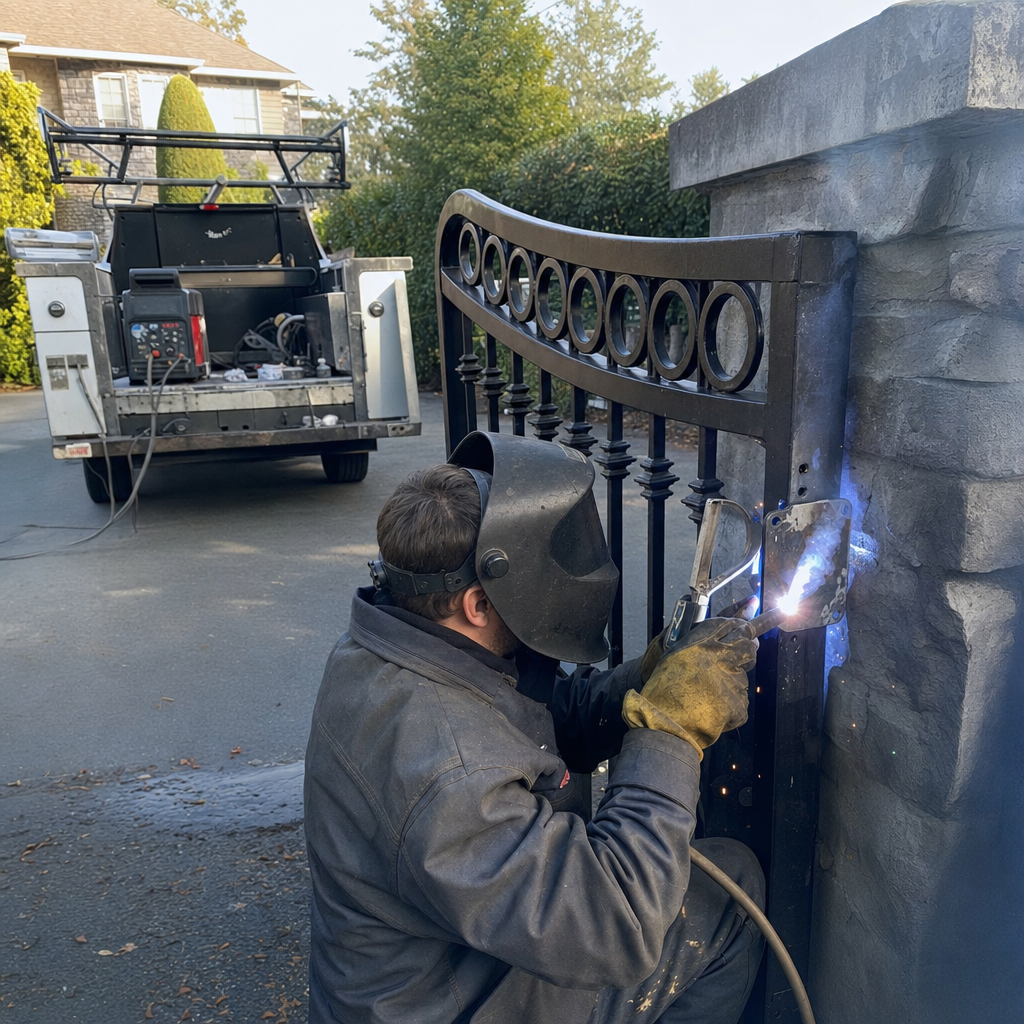
Electric Gate Repair Cost in Vancouver, WA: What You’ll Actually Pay in 2024
Gate Repair Near Me in Vancouver, WA typically runs $185 to $650 depending on whether you’re fixing a simple electrical component or correcting a structural problem that’s masquerading as one. Most homeowners we see in Clark County fall somewhere in the $275–$425 range for a properly diagnosed, lasting repair. Call (833) 719-7067 for a free, same-day estimate — Stephen Rogers, our owner and lead technician, handles every diagnostic personally.
Here’s the uncomfortable truth we’ve learned over 11 years and 527 reviews: a lot of “electrical” gate problems in Vancouver aren’t electrical at all. The Gorge wind events and freeze-thaw cycles that hit this area harder than Portland proper slowly shift gate posts out of plumb. Then the automatic opener strains, the control board throws error codes, and a technician who doesn’t check structure first replaces your circuit board twice at $340 a pop while the real problem — a post that moved a quarter inch last February — goes untouched.
We’ve made that call hundreds of times. It’s why our diagnostic always starts with a level on the post, not a multimeter on the board.
Why Vancouver’s Climate Creates Misdiagnosed “Electrical” Problems
Vancouver sits at the western mouth of the Columbia River Gorge, and those east wind events aren’t just unpleasant — they’re a mechanical stress test for automatic gates. Sustained gusts of 40–70 mph apply lateral load cycles that Portland gates simply don’t experience. Meanwhile, our wet winters and hard freezes create ground movement at the post base that throws alignment off by degrees too small to see but large enough to bind a gate at the top of its swing arc.
When a gate binds, the motor draws excess amperage. The control board detects the overload and either faults out or starts behaving erratically — random reversals, partial openings, or complete shutdowns. A technician who treats this as an electrical problem replaces the board, maybe the motor too, and charges you $600–$900. Six months later, the new board is faulting because the post moved another eighth of an inch.
In neighborhoods like Fruit Valley and Garrison, where mid-century ranch homes still run original steel hardware on aging wood frames, we’ve seen this pattern repeat for decades. In the 1990s–2010s subdivisions up in Salmon Creek and Felida, where vinyl privacy gates and ornamental aluminum driveway gates are now hitting their first major repair cycle simultaneously, the same freeze-thaw mechanics apply — just with different materials fatiguing differently.
The fix is structural, not electrical: resetting or re-pouring the post footing, realigning the gate, and only then assessing whether the electrical components actually sustained damage from the months of overload. That structural correction typically runs $275–$450. Replacing electrical components that were never the root cause can run triple that with zero lasting result.
Honest Cost Breakdown: Electrical vs. Structural Repairs
We separate every quote into two categories so customers know exactly what they’re paying for. Here’s what How Much Does Gate Repair Cost? (2026 Price Guide) — Vancouver, WA actually looks like when diagnosed correctly:
| Repair Category | Specific Component | Typical Cost Range |
|---|---|---|
| Electrical Component Replacement | Control board (standard residential) | $280–$420 |
| Control board (heavy-duty/commercial) | $450–$680 | |
| Safety sensor pair (wired) | $165–$245 | |
| Battery backup unit | $140–$220 | |
| Wiring & Connection Repairs | Ground conduit entry rewiring (freeze-thaw damage) | $185–$325 |
| Low-voltage control wire replacement (per run) | $125–$195 | |
| Photo-eye alignment (post-movement related) | $95–$165 | |
| Structural/Mechanical Corrections | Post reset/realignment (single post) | $275–$425 |
| Hinge replacement (heavy-duty, wind-load rated) | $195–$340 | |
| Gate frame weld repair (in-house) | $165–$290 | |
| Motor/Opener Service | Opener arm rebuild or replacement | $340–$580 |
| Motor capacitor or gear assembly | $225–$385 |
These ranges reflect our actual 2024 pricing for Vancouver-area jobs, including parts and labor. We don’t markup parts to “make up” for diagnostic time — Stephen sources directly and passes supply costs through at cost plus standard retail margin. The welding capability is in-house, so structural repairs don’t get outsourced to a third party with their own markup.
How Vancouver’s Weather Destroys Specific Electrical Components
Not all electrical failures are misdiagnosed structural problems. Some are genuine component casualties of our specific climate. Here’s what we replace most often, and why:
Control boards from wind-driven rain infiltration. Exposed above-ground operators — especially budget units mounted on post brackets without adequate hood coverage — take direct spray during Gorge wind events. Water finds the enclosure seam, corrodes traces, and causes intermittent faults that look like programming issues. We’ve replaced more LiftMaster residential boards after January windstorms than any other single call type. FAAC and BFT underground operators avoid this entirely by design — the motor and control housing sit below grade in a sealed casing — which is why we recommend them for exposed Vancouver installations despite higher upfront cost.
Wiring at ground conduit entry points. PVC conduit expands and contracts with freeze-thaw cycles. After enough winters, the seal at the junction box cracks, groundwater wicks in, and copper degrades. The symptom is often a gate that works fine at 2 PM but won’t respond at 7 AM — moisture bridging conductors overnight, evaporating by afternoon. We see this constantly in the older neighborhoods near downtown where original conduit was direct-burial PVC without proper sweep elbows.
Safety sensor misalignment from post movement. Photo eyes need to “see” each other within a few millimeters of parallel. When a post leans even slightly, the beam misses the receiver. The gate opens fine (no safety check needed) but won’t close (safety interlock active). Technicians who don’t level the post first will replace “faulty” sensors repeatedly. We’ve been called to homes in Orchards where three different companies had swapped sensors before someone finally put a level on the post.
Battery backup units from cold-weather discharge. Lead-acid and even lithium backup batteries lose significant capacity below 40°F. Vancouver’s winter lows, combined with gates on north-facing slopes that never see sun, kill batteries in 18–24 months instead of the rated 3–5 years. Mighty Mule’s residential battery kits are particularly susceptible — the compact enclosure doesn’t allow enough thermal mass to moderate temperature swings. We keep higher cold-amp-hour replacements in stock specifically for this.
The Diagnostic Order That Saves You Money
Stephen Rogers — owner and lead technician at Cardinal Gate Repair Vancouver — follows the same sequence on every electric gate call, and it’s the opposite of what most technicians do:
- Structural check first: Post plumb with a 4-foot level. Gate swing clearance through full arc. Hinge pin wear and lateral play. Track alignment for sliding gates. No tools touch electrical components until this is documented.
- Mechanical load test: Disconnect the opener and operate the gate manually. If it binds, drags, or requires excessive force, the electrical system is working against a mechanical problem. Fix the mechanics first.
- Electrical diagnosis only after mechanical clearance: Now we check amperage draw, control board fault codes, sensor alignment with the gate actually moving freely, and wiring continuity.
This order isn’t slower — it’s faster. A structural fix that takes 90 minutes and costs $325 eliminates the need for a $400 control board replacement. We’ve had customers in Felida tell us we “undercharged” them because the previous company quoted $1,200 for electrical work that we resolved with a post reset and hinge adjustment in under two hours.
That’s not luck. That’s 11 years of seeing the same post-lean-masquerading-as-electrical-fault pattern hundreds of times. Pattern recognition has real monetary value when you’re paying for the technician’s judgment, not just their truck roll.
Brand-Specific Repair Realities in Vancouver Conditions
Our factory-familiar experience across nine brands means we know which systems hold up to Gorge wind and freeze-thaw, and which become money pits. This matters for repair cost forecasting:
FAAC and BFT underground operators — The motor and control housing sit in a sealed subgrade casing, completely protected from wind-driven rain. In Vancouver’s exposed locations, these have the lowest long-term electrical repair cost of any system we service. The tradeoff is higher installation complexity and slightly slower initial response time. When we do repair them, it’s usually mechanical (hinge, gate, or track) rather than electrical.
LiftMaster residential above-ground units — Excellent internal engineering, but the standard hood coverage is marginal for direct Gorge exposure. We see more control board and logic module replacements on these than any other brand in Vancouver specifically — not because LiftMaster builds poorly, but because the installation location is often under-specified for our wind load. Elite’s comparable residential units have slightly better enclosure sealing, in our field experience.
Mighty Mule — Budget-friendly for good reason. The control enclosures are minimal, battery compartments are undersized for cold climates, and the DIY installation market means many units in Vancouver were mounted by homeowners without proper wind-load consideration. Repair costs stay low (parts are cheap) but recurrence is high. We fix them when asked, but we’re honest about expected service life.
When someone calls us after a “reputable” company has replaced electrical components twice with no lasting fix, the brand story usually reveals itself: an above-ground operator in an exposed location, installed without wind-load calculation, now being treated as an electrical mystery. It’s not a mystery. It’s Vancouver.
Common Local Scenarios: What We Actually Quote
Here are three real call types from the past year, with actual cost outcomes:
The Salmon Creek vinyl gate that “just stopped working.” 2018 installation, Mighty Mule opener, north-facing slope. Battery was dead from cold discharge, but the root cause was post lean from freeze-thaw that put the gate slightly out of plumb, causing the motor to work harder and cycle the battery more frequently. We reset the post, replaced the battery with a cold-weather-rated unit, and realigned the safety sensors. Total: $385. Previous quote from another company: $780 for new opener and “electrical troubleshooting.”
The Fruit Valley craftsman with random reversals. Original 1960s steel gate, retrofitted with Linear opener in 2015. Post had leaned enough that the gate bound at 85% of swing arc. Control board was throwing “obstruction detected” errors correctly — there was an obstruction, it was the gate frame hitting a leaning post. Two prior companies had replaced the board and “adjusted force settings,” which is dangerous on a binding gate. We corrected the post, welded a cracked gate frame bracket in-house, and confirmed the original board was fine. Total: $425. Customer had already spent $640 on unnecessary electrical parts.
The Felida HOA ornamental aluminum gate with intermittent response. Ghost Controls dual opener, exposed to full Gorge wind. Ground conduit entry had cracked from freeze-thaw, moisture was wicking into low-voltage control wiring. Symptoms were intermittent because the moisture bridge varied with temperature and humidity. We replaced the conduit run with proper sweep elbow and expansion joint, spliced wiring with waterproof connectors, and sealed the new entry. Total: $295. No electrical components were actually faulty.
These aren’t cherry-picked. They’re representative of why we lead with structure before electricity, and why our average repair cost lands lower than competitors who replace parts speculatively.
FAQs
Most electric gate repairs in Vancouver, WA cost between $275 and $425 for a properly diagnosed fix that addresses the root cause. Simple electrical component replacements like safety sensors or battery backups run $140–$245, while structural corrections like post realignment or hinge replacement typically fall in the $275–$425 range. Misdiagnosed jobs that replace electrical components without fixing structural problems often push total costs past $800 with no lasting result. Call (833) 719-7067 for a free estimate — we’ll tell you whether your issue is electrical, structural, or both before any work begins.
Repair is almost always cheaper if the opener is under 10 years old and the problem is isolated to one component — a control board, gear assembly, or capacitor replacement typically runs $225–$580 versus $1,200–$2,400 for full opener replacement with installation. However, if the opener is a budget brand like Mighty Mule that’s already required multiple repairs, or if it’s improperly sized for Vancouver’s wind load, replacement with a correctly specified unit becomes the more economical long-term choice. Stephen Rogers assesses this honestly — we’ve walked away from repair jobs where replacement was clearly the better value, and we’ve rebuilt 12-year-old LiftMaster units that still had years of life with one component swap.
Yes, we offer Emergency Gate Repair in Vancouver, WA with same-day service for most electric gate repairs in Vancouver and Clark County when you call before early afternoon. We stock control boards for LiftMaster, Linear, FAAC, and BFT; safety sensors; batteries; and common hinge and hardware sizes. Our in-house welding capability means we can fabricate or repair structural components on-site without waiting for parts orders. For calls involving underground operators or HOA-matched specialty finishes in north Vancouver subdivisions along SR-502 or SR-503, next-day completion is more realistic due to parts sourcing complexity. Call (833) 719-7067 — we’ll give you an honest timeline based on your specific gate and location.
Random reversal or stopping almost always indicates either an obstruction in the gate’s path (including one caused by post lean or hinge wear) or a safety sensor that’s misaligned or detecting a false signal. In Vancouver specifically, we’ve found that post movement from freeze-thaw ground shift is the single most common root cause — the gate binds slightly, the motor detects excess resistance, and the safety logic reverses the gate as designed. Technicians who don’t check structural alignment first often replace control boards and sensors repeatedly without fixing the actual problem. Our diagnostic starts with a level on the post and a manual swing test before any electrical testing. If your gate is behaving erratically, call (833) 719-7067 — we’ll find the real cause instead of guessing at parts.
What to Expect When You Call Cardinal Gate Repair Vancouver
Stephen Rogers answers most calls directly or returns them within the hour. He’ll ask for your gate brand if you know it, the symptoms you’re seeing, and whether the problem started suddenly or gradually. That conversation alone often narrows the diagnostic significantly — “started after last week’s windstorm” points different directions than “getting worse for six months.”
We show up in a marked truck, diagnose on-site, and explain what we found before quoting. No dispatchers, no rotating crews, no upsell pressure. Our Gate Repair service covers the full ecosystem: mechanical, electrical, access control, and structural — one technician, one accountability chain.
Eleven years, 527 reviews at 4.7 stars, and one simple standard: tell me the symptom, I’ll tell you the part — no guessing, no upselling. That’s how we’ve built Cardinal Gate Repair Vancouver into the call locals make when they’re tired of paying for other people’s misdiagnoses.
Ready for an honest diagnosis and a repair that lasts? Call (833) 719-7067 for your free estimate today.
Written by Stephen Rogers, Owner & Lead Technician at Cardinal Gate Repair Vancouver, serving Vancouver, WA.