
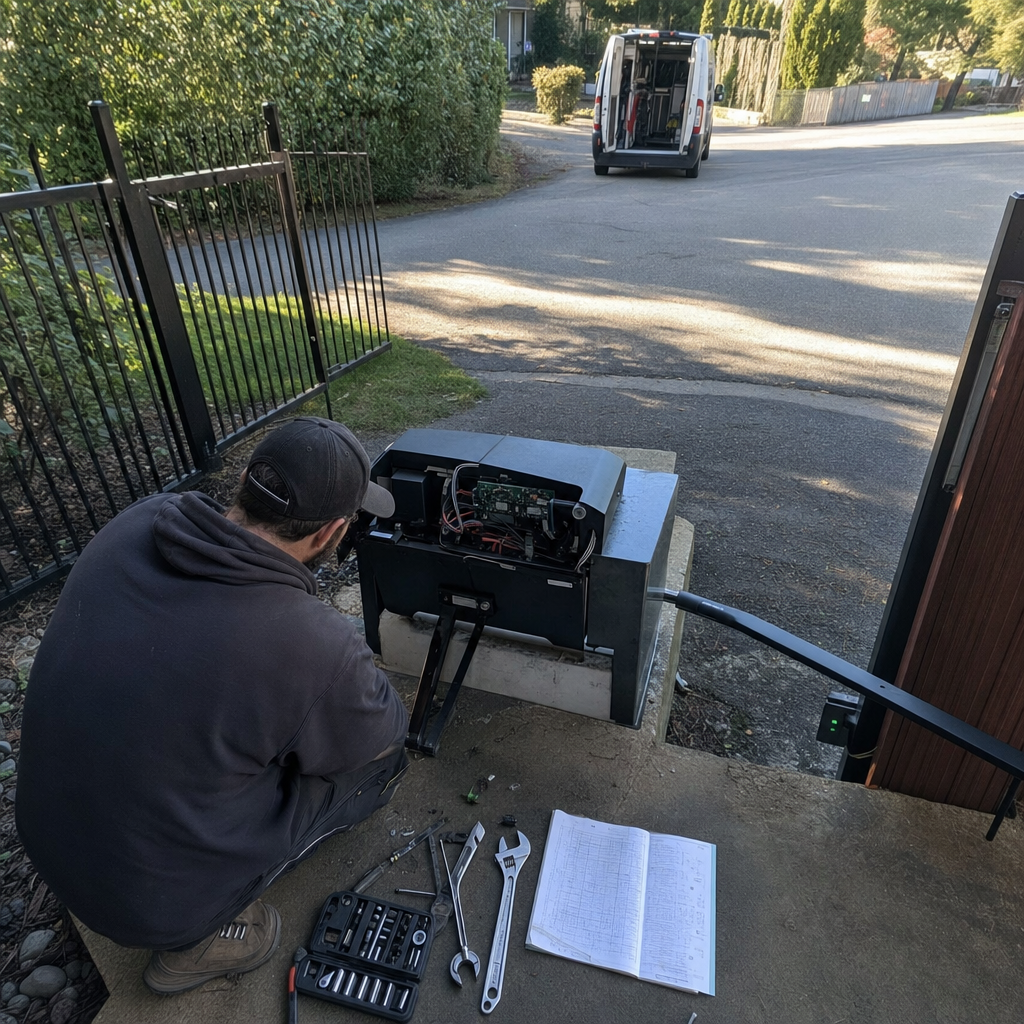
Why Won’t My Automatic Gate Open in Vancouver, WA? The #1 Cause Is Wind Damage to the Operator Arm
If your automatic gate won’t open and the motor light is blinking or the unit hums briefly then stops, your operator has likely entered fault-protection mode after detecting resistance it couldn’t overcome. In Vancouver, WA, this happens most often after a Columbia River Gorge east-wind event bends or displaces the operator arm just enough to change the gate’s travel arc, triggering the obstruction sensor. The motor isn’t dead — it’s protecting itself from burnout. Call (833) 719-7067 if you need the gate opened today; we’ll diagnose it in person and give you a straight answer on whether it’s a ten-minute adjustment or a welded repair.
How the Obstruction-Detection Shutdown Actually Works
Every modern automatic gate operator — whether it’s a LiftMaster, FAAC, Viking, or Mighty Mule — contains a current-sensing circuit that monitors how hard the motor is working. When the gate encounters more resistance than the factory threshold allows, the controller assumes something or someone is blocking the path. It stops the motor, flashes a diagnostic code, and refuses further commands until the condition is cleared or the unit is manually reset.
Here’s where Vancouver’s geography makes this feature feel like a failure. The city sits at the western mouth of the Columbia River Gorge, and when those east winds channel through at 40–70 mph, they don’t just rattle your gate — they apply sustained lateral force against the operator arm, the gate leaf, and the posts. After the wind dies down, you might have:
- A slightly bent operator arm that now travels through a different arc
- A gate leaf that’s shifted on its hinges, changing the closing angle
- A post that’s leaned just enough to bind the gate at mid-travel
The operator detects this as “obstruction.” It isn’t wrong — something is blocking normal travel — but it’s not a person or a car. It’s geometry changed by wind.
We’ve seen this pattern repeat across Salmon Creek, Felida, and Orchards after every major east-wind event. The 1990s–2010s tract developments out there are full of vinyl privacy gates and ornamental aluminum driveway gates now hitting their first major repair cycle, and their lighter construction makes them especially susceptible to wind displacement. Meanwhile, the mid-century ranch and craftsman homes near downtown in Fruit Valley, Garrison, and Lincoln often have aging wood-framed gates on original steel hardware — heavier, but the posts rot at the base from sustained ground moisture, and the whole assembly leans over time.
Stephen Rogers — owner and lead technician at Cardinal Gate Repair Vancouver — has spent 11 years tracing these exact failure patterns across Clark County. “Tell me the symptom, I’ll tell you the part — no guessing, no upselling.” That’s how we approach every call.
How to Tell Wind Damage from a True Electrical Failure
Before you assume the motor is fried, run through these checks. They take five minutes and can save you a service call — or at least tell you exactly what to tell us when you call.
Check the diagnostic indicators
Most operators flash a specific code when in fault mode. On a LiftMaster LA500 or CSW series, a flashing red or amber LED typically indicates an obstruction fault. Count the flashes — two flashes, pause, repeat usually means excessive force detected during closing. On FAAC 746 and 844 models, the control board LED changes from steady green to flashing red or orange. Viking operators use a numeric display or flash sequence that corresponds to fault codes in the manual.
If you see any patterned flashing, the electrical system is alive and communicating. A truly dead motor — blown control board, failed transformer, seized gearbox — gives you nothing: no light, no hum, no response.
Listen for the telltale hum
Press your remote and put your ear near the operator. A brief hum (one to three seconds) followed by silence strongly suggests the motor tried to move, encountered resistance beyond its force setting, and shut down. This is the classic signature of a mechanical obstruction, not an electrical failure.
Test the manual release
Every automatic gate operator has a manual release — usually a key switch, lever, or pull cord. If the gate moves freely by hand after release, the mechanical path is clear and the problem may be in the motor or control board. If it binds or requires excessive force, you’ve got a physical obstruction or misalignment. Do not force it. Forcing a bound gate can bend the operator arm further, strip gears, or damage the limit switch.
Inspect the operator arm and gate path
Look for visible bends in the operator arm, gaps where the gate meets the post, or scraping marks on the ground or gate frame. Even a quarter-inch of post lean can change the geometry enough to trigger fault mode on a sensitive operator.
The Five Most Common Causes in Vancouver, Ranked by What We Actually See
After 527 customer reviews and 11 years of continuous operation in this market, here’s the actual frequency of what stops automatic gates in Vancouver, WA:
| Cause | What It Looks Like | Typical Repair |
|---|---|---|
| 1. Wind-caused arm displacement or post lean | Gate worked yesterday, won’t open after wind; blinking fault light; brief hum then stop | Arm straightening or replacement; post resetting or reinforcement; $180–$450 |
| 2. Ground movement shifting gate alignment | Gradual worsening; gate drags or binds at same point in travel; seasonal pattern | Hinge adjustment; track realignment; post leveling; $150–$380 |
| 3. Dead or weak battery backup | Gate works intermittently; slow operation; fails during power fluctuation | Battery replacement; charging circuit test; $85–$220 |
| 4. Photo-eye obstruction or misalignment | Gate starts then reverses; no fault code on some models; visible debris on sensor | Cleaning; realignment; sensor replacement if cracked; $75–$195 |
| 5. Remote battery or frequency interference | Wall button works, remote doesn’t; multiple remotes fail simultaneously suggests interference | Battery replacement; reprogramming; antenna adjustment; $0–$150 |
Notice what’s not on this list: complete motor failure. In 11 years, we’ve found truly dead control boards or seized gearboxes in maybe 5% of “my gate won’t open” calls. The other 95% are mechanical or adjustment issues that a general handyman misdiagnoses as “you need a new opener.”
Safe Manual Override: Getting Your Gate Open While You Wait
If you’re stuck inside or outside your property and need the gate open now, here’s how to use the manual release on the two most common residential brands in Vancouver’s tract developments. These procedures are for emergency access only — they are not repair instructions. If the gate is heavy, on a slope, or you’re unsure of the mechanism, wait for a trained technician. Automatic gates can weigh several hundred pounds and cause serious injury if they move unexpectedly.
LiftMaster LA500 / CSW24U / RSW series
Locate the manual release key switch on the operator housing — it’s a small cylinder lock, usually on the front or side. Insert the key (typically provided with the operator, or a standard release key available from Cardinal Gate Repair Vancouver) and turn to the release position. You’ll feel the clutch disengage. The gate should now move freely by hand. Support the gate before releasing — on a sloped driveway, a heavy swing gate can swing shut with force. Once released, the gate will not respond to remote commands until you return the key to the normal position.
Ghost Controls TSS1 / DTP1 series
These operators use a pull-cord manual release. Open the operator cover and locate the red or yellow release handle on the motor carriage. Pull firmly downward until you hear or feel the clutch disengage. The gate arm will now move independently. Do not operate the motor electrically while the release is engaged — this can strip the internal limit switch or damage the controller. Return the handle to its original position before restoring power.
If your gate uses a Mighty Mule or BFT system, the release mechanism varies by model — some use a lever, others a keyed switch. We carry release keys and can walk you through your specific model over the phone if you’re unsure.
The One Thing That Turns a $150 Repair Into a $400 One
When the gate doesn’t respond, the instinct is to press the remote again. And again. Maybe hold it down longer. Maybe try the other remote. Maybe cycle the breaker.
Here’s what that does when the operator is in fault mode: each failed start attempt sends current spikes through the motor controller. The controller is already stressed from the original overload. Repeated cycling can burn out the relay, corrupt the limit switch position memory, or — on older LiftMaster boards — fry the surge protection components that guard against exactly this kind of abuse.
We’ve replaced perfectly good control boards because a homeowner “tried it twenty times” over a weekend. The original problem was a bent operator arm that we could have straightened in twenty minutes. The repeated cycling added a $250 board replacement to a Electric Gate Repair Cost in Vancouver, WA service call.
If the gate doesn’t move on the second attempt, stop. Check the indicators. Use the manual release if you need access. Then call someone who can diagnose the actual failure mode without guessing.
Why Vancouver’s Climate Makes This a Recurring Problem
The combination of Gorge east-wind events and Pacific Northwest moisture creates a failure pattern we don’t see in Portland or even across the river in Oregon. The winds apply repetitive lateral loads that fatigue hinges, loosen post footings, and gradually bend operator arms. Then the sustained wetness — ground moisture, wind-driven rain, freeze-thaw cycles — accelerates corrosion in the hardware and rot in wood components.
We’ve found automatic gate openers in exposed locations along SR-502 and SR-503 corridors with control boards failed from wind-driven rain infiltration. The large HOA-governed subdivisions out there enforce specific gate material and color standards, so when a component does fail, sourcing a matching vinyl or powder-coat finish becomes part of the repair — not just swapping a generic part.
This is why we maintain in-house welding capability and parts sourcing. When Stephen Rogers arrives at a job, he can straighten a bent arm, fabricate a bracket, or weld a cracked hinge on the spot rather than ordering a replacement that may not match HOA requirements. Repair first, replace only when necessary.
When to Call Cardinal Gate Repair Vancouver
Some gate problems are safe to investigate yourself. Others involve high-tension components, heavy gates on slopes, or electrical systems that can cause injury if mishandled. Call (833) 719-7067 if:
- The gate is on a slope and could move unexpectedly during manual release
- You see damaged wiring, burning smell, or sparking from the operator
- The operator arm is visibly bent or cracked — welding or replacement is needed
- The post is leaning or the gate frame is twisted — structural repair required
- You’re unsure of your manual release mechanism and need guidance
- Repeated remote attempts haven’t worked — protect the controller from further damage
We carry Best Gate Repair in Vancouver, WA expertise across nine brands: LiftMaster, FAAC, BFT, Linear, Viking, Ghost Controls, DoorKing, Elite, and Mighty Mule. Stephen Rogers handles every diagnostic personally — owner and lead technician, not a rotating subcontractor. From the motor to the hinge, we cover the entire gate, not just one component.
Gate Repair is our core service, but we also handle full gate installation, motor and opener replacement, access control systems, and structural welding — one call, full resolution.
FAQs
The most likely cause is that Gorge east winds have bent or displaced your operator arm, changing the gate’s travel arc enough to trigger the motor’s obstruction-detection circuit. The motor enters fault-protection mode and refuses to operate until the mechanical issue is resolved. This is a safety feature, not motor failure — but repeated remote attempts can damage the controller. Call (833) 719-7067 for a same-day assessment; estimates are free.
Most repairs for a gate that won’t open run $150–$450 in the Automatic Gate Repair Cost in Vancouver, WA market, depending on whether the issue is an adjustment, component repair, or structural welding. Simple photo-eye realignment or battery replacement falls at the low end; operator arm straightening or post resetting after wind damage runs mid-range; control board replacement from repeated overload cycling hits the higher end. We’ll give you an exact quote after hands-on diagnosis — no upselling, no replacement-by-default.
Yes — every automatic gate operator has a manual release mechanism, but the procedure varies by brand and involves safety risks with heavy gates or sloped driveways. LiftMaster systems use a keyed release switch; Ghost Controls use a pull-cord handle. Support the gate before releasing, as it may move with significant force. If you’re unsure of your mechanism or the gate is on a slope, wait for a trained technician rather than risk injury or further damage. Call (833) 719-7067 and we can guide you through your specific model.
Repair is almost always cheaper and is our default approach. In 11 years and 527 reviews, we’ve found that roughly 95% of “dead” gate openers are actually suffering from mechanical misalignment, adjustment issues, or minor component failure — not true motor death. Our in-house welding and parts capability means we fix what others replace. Full replacement typically only makes sense when the operator is 15+ years old, parts are obsolete, or multiple major components have failed. We’ll tell you honestly which category you’re in.
If you’d rather have it looked at, Cardinal Gate Repair Vancouver offers a no-pressure assessment in Vancouver — call (833) 719-7067 for a free estimate. Stephen Rogers handles every diagnostic personally, and we’ll have your gate moving the same day in most cases.
Written by Stephen Rogers, Owner & Lead Technician at Cardinal Gate Repair Vancouver, serving Vancouver, WA.